About Lysiphragma epixyla Meyrick, 1888
Lysiphragma epixyla, first described by Meyrick in 1888, has detailed descriptions of its larvae, pupae, and adult moths from Hudson and Meyrick.
Hudson described the full-grown larva as reaching about 1 inch in length. The head is bright reddish-brown, the second segment is horny, polished, and yellowish-brown. Segments 3 and 4 are greyish-ochreous with a single row of minute warts and long bristles. The rest of the body is dull whitish-ochreous. Except for the terminal segment, every segment has two elongate dorsal plates and five minute greyish lateral plates. Each dorsal plate bears two warts, and each lateral plate bears one wart; every wart produces a long bristle. The terminal segment is dull brown with many bristles. The pupa is contained within a loose cocoon made of silk and frass, located inside decayed wood.
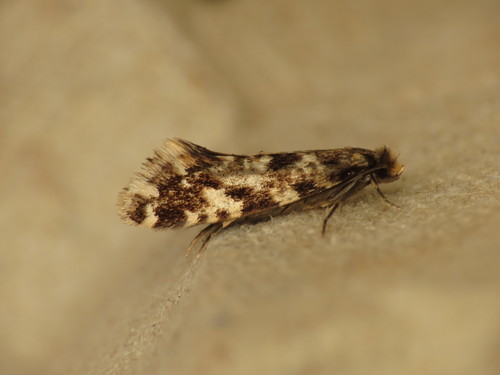
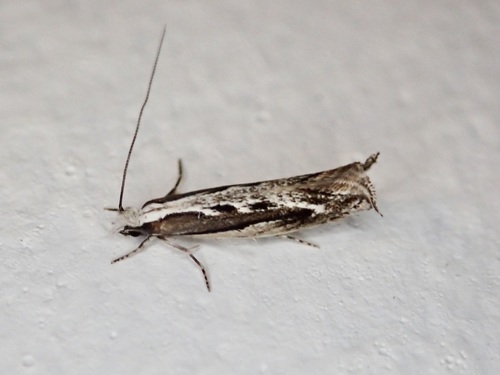
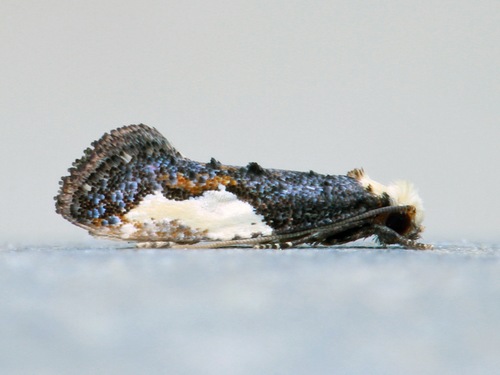
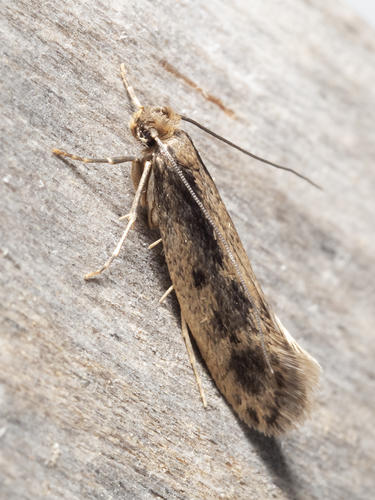
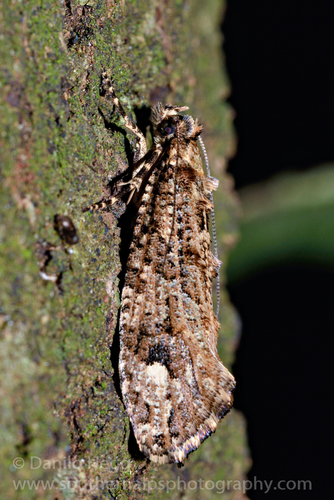
Meyrick described adult moths of both sexes as having a wingspan of 24-29 mm. The head and palpi are whitish-ochreous mixed with dark fuscous. Antennae are whitish-ochreous, with dark fuscous spots on the upper surface. The thorax is dark fuscous speckled with whitish-ochreous, and the posterior margin is sometimes entirely whitish-ochreous. The abdomen is whitish-ochreous speckled with grey. The legs are dark fuscous, with blurry whitish-ochreous rings; posterior tibiae are whitish-ochreous. Forewings are elongate, with a moderately arched costa, obtuse apex, and a very obliquely rounded hindmargin. They are whitish-ochreous, irregularly suffused with fuscous, and more or less strongly coarsely speckled with blackish. There are four scale tufts: a large tuft very close to the base, a small one near the inner margin at one-quarter, a third on the fold opposite the middle of the inner margin, and a fourth above the anal angle. Blackish speckling tends to form two triangular blotches, whose apices touch the inner margin at one-third and two-thirds. There is an ill-defined roundish ochreous-whitish spot before the apex, preceded by a blackish-fuscous suffusion that forms the margin of the spot. Cilia on the forewings are fuscous, speckled with dark fuscous toward the base, and very faintly spotted with ochreous-whitish. Hindwings are whitish-fuscous; their cilia are fuscous-whitish with a faint darker line.
Unlike its green-colored sister species Lysiphragma mixochlora, L. epixyla is brown. The depth and extent of light and dark wing markings in this species vary considerably. This moth is endemic to New Zealand, and has been observed in both the North and South Islands. It lives in dense native forest. Its larvae feed under the bark of dead pukatea, tree fuchsia, kapuka, and hinau, and also feed under old wood of beech trees in the genus Nothofagus.