About Lysimachia terrestris (L.) Britton, Sterns & Poggenb.
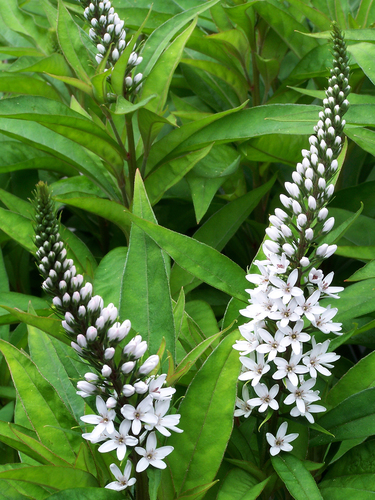
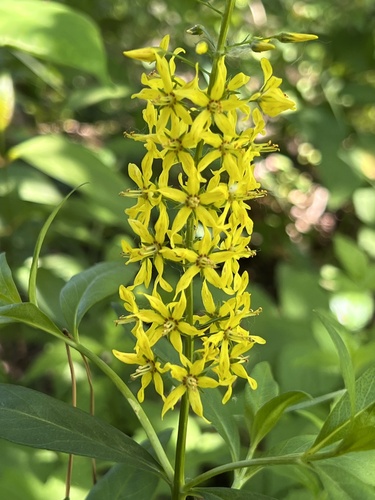
Lysimachia terrestris (L.) Britton, Sterns & Poggenb. is a herbaceous plant with opposite, simple leaves and erect stems. Its flowers grow in a 10–30 cm (4–12 inch) long raceme at the top of the plant. The blooms are star-shaped with five yellow petals, and they appear in mid-summer. Each petal has two red dots at its base, which together form a circle of ten red dots at the center of the flower. Late in the summer, reddish bulblets develop in the leaf axils; these structures resemble caterpillars, and may be mistakenly identified as fruit. In terms of ecology and distribution, Lysimachia terrestris grows in swamps and along the edges of ponds and lakes. It is found across Eastern Canada and the Eastern United States, and also occurs in the U.S. states of Oregon, Washington, and Idaho, as well as in British Columbia. It is listed as endangered in the U.S. states of Tennessee and Kentucky. A major pest of this species is Monostegia abdominalis, a sawfly whose larvae can fully skeletonize the plant's leaves.