About Lysimachia monelli (L.) U.Manns & Anderb.
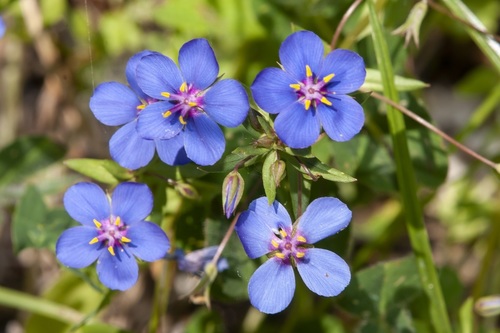
Lysimachia monelli, commonly called blue pimpernel or garden pimpernel, was formerly classified as Anagallis monelli. It is a species of flowering plant in the family Primulaceae, native to the Mediterranean region, specifically the Iberian Peninsula, Northwest Africa, Corsica, Sicily, and the Balearic Islands. It should not be confused with Lysimachia foemina, which has very similar blue flowers but broader leaves, and can also grow in colder climates. Comparisons of DNA sequences have shown L. monelli is most closely related to L. foemina. Before this genetic analysis, many researchers thought L. foemina was most closely related to L. arvensis, and some authors even classified L. foemina as a subspecies of L. arvensis. All three of these species were among several that were moved from the genus Anagallis to the genus Lysimachia in a 2009 publication. Lysimachia monelli is a low-growing perennial with trailing stems. Wild populations of the species produce either blue or orange flowers, and the two color variants do not grow in the same native ranges: blue-flowered plants are native to southern Spain, while orange-flowered plants are native to Morocco and southern Italy. A red-flowered variant has been developed through breeding at the University of New Hampshire. Orange flowers have a higher concentration of pelargonidin pigment, blue flowers have a higher concentration of malvidin, and red flowers get their color from the specific relative concentrations of delphinidin and malvidin pigments. Along with the blue, orange, and red forms, a white-flowered form of the species also exists. Even though L. monelli is a perennial, it is often grown as an annual when cultivated in temperate regions. Under its former name Anagallis monellii, this plant has been awarded the Royal Horticultural Society's Award of Garden Merit.