About Lysimachia arvensis (L.) U.Manns & Anderb.
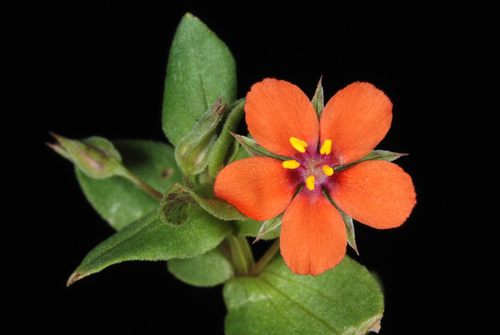
Scarlet pimpernel, with the scientific name Lysimachia arvensis (L.) U.Manns & Anderb., can grow as either a summer annual or a winter annual. Summer annual plants have a low-growing creeping habit, while winter annual plants form a half-rosette with an upright stem. It produces weak, sprawling stems with a square cross-section that reach 5–30 centimetres (2–12 in) in length. Stems bear bright green, soft, ovate sessile leaves arranged in opposite pairs. Its radially symmetric flowers, which grow singly in leaf axils from spring to autumn, are 10–15 millimetres (0.4–0.6 in) in diameter and may be orange, red, or blue. Petal margins are slightly crenate and bear small glandular hairs. The stamens have lollipop-shaped hairs that attract a range of pollinators, especially flies, though the species is also capable of autopollination. In the northern hemisphere, its dehiscent capsule fruits ripen from August to October. The weight of the mature fruiting body bends the stem, and seeds are dispersed by wind or rain. Blue-flowered plants, treated as L. arvensis f. azurea by some sources, are common in some regions, including the Mediterranean. These blue plants should not be confused with the related species blue pimpernel, Lysimachia foemina. In 2007, a molecular phylogenetic study found that L. foemina is more closely related to Lysimachia monelli than to L. arvensis, confirming it should be treated as a separate species; at the time of the study, all three species were placed in the genus Anagallis. This species has a diploid chromosome count of 2n=40. Scarlet pimpernel flowers open only under sunny conditions, and close even in overcast weather. This characteristic habit gave it common nicknames such as "shepherd's weather glass". It has been observed growing along the verges of salted roads, forming a broad red band along the roadside. The species displays a wide range of flower colours, which many sources treat as distinct forms. However, Plants of the World Online does not recognize any intraspecific subdivisions within this species. For the named forms, the type arvensis has bright red to minium-coloured petals; carnea has deep peach petals; lilacina has lilac petals; pallida has white petals; and azurea has blue petals. The blue form can be hard to distinguish from L. foemina, but petal margin features are diagnostic. L. foemina has clearly irregular petal margins with only 5 to 15 glandular hairs, while L. arvensis f. azurea has only slightly irregular petal margins with 50 to 70 glandular hairs. Lysimachia arvensis is a cosmopolitan invasive species that is generally considered unwanted. It is toxic in multiple ways, making it undesirable in pastures. The plant tastes acrid and bitter, so grazing livestock typically avoid eating it unless the area is overgrazed or they are grazing unsatisfying stubble. Experimental feeding of this plant material to animals including horses and dogs caused gastroenteritis, and sufficiently high doses were fatal. There are also general reports that the herb is toxic to poultry and rabbits, and the seed is toxic to birds. L. arvensis is less commonly used in global folk medicine than it is in its native regions. Across various native countries, plant material has been applied externally to treat slow-healing ulcers and wounds. It has also been used as an expectorant, and as a folk remedy for pruritus, rheumatism, haemorrhoids, rabies, leprosy, and snake-bite. It has been used to treat unspecified types of phthisis, and kidney-related conditions including dropsy and chronic nephritis. In ancient Greece, it was used as an antidepressant, and it was used to treat various mental disorders in European folk medicine; this use led to its German name Gauchheil, combining words meaning "fool, cuckoo" and "heal". There is currently no documented evidence supporting the clinical efficacy of this plant for any medical use. Traditionally, pharmacists know the species as Arvensis Herba. L. arvensis is insecticidal, or at least repels some insects, likely due to its pungent, characteristically scented essential oil. When taken by mouth, experimental doses of the plant's liquid caused 24 hours of intense nausea, headache and bodily pain in humans. Some people also develop contact dermatitis from touching the plant's leaves. Reports from Australia note that when grain crops become infested with this weed, chaff containing large amounts of the plant becomes unpalatable to livestock as fodder. Livestock typically avoid the plant when grazing, but if they eat significant quantities, they experience intense diuretic and narcotic effects, which confirms the plant's poisonous status. There is a reported Indian practice of using the plant to expel leeches from dog nostrils, which can lead to death if the dog swallows the plant fluid. The herb and its seeds contain saponins, which may explain why fresh plant material is strongly haemolytic. Alongside other potential glycosides, the root produces the highly toxic triterpenoid glycoside cyclamin. Cyclamin also occurs in Cyclamen species, which are also members of the subfamily Myrsinoideae. The plant also contains tanning agents, bitter compounds, and the proteolytic enzyme primverase. Antibacterial tests conducted on the green parts of the plant did not find any encouraging positive antibacterial effects.