About Lysiloma candidum Brandegee
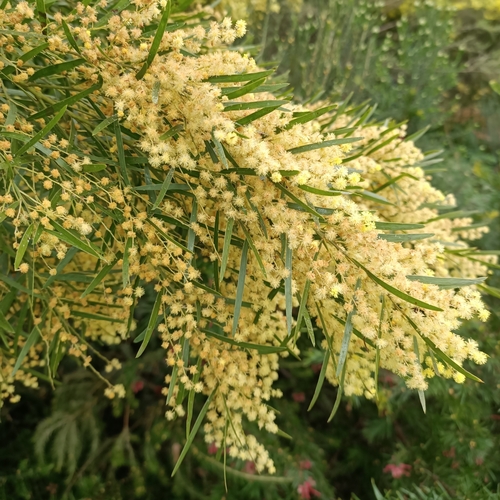
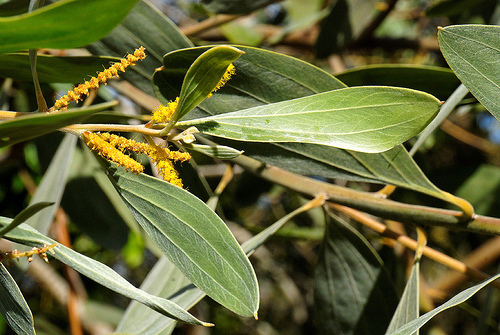
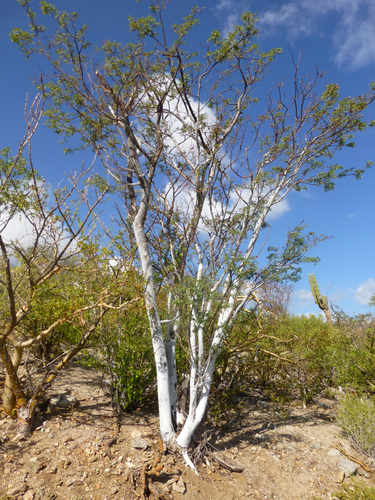
Lysiloma candidum Brandegee typically grows as a tree with a slender, straight, dichotomously branched trunk, reaching up to 10 metres (33 ft) in height. Its bark is smooth and silvery white, while the bark on its small branches is dark. The compound leaves of this species measure 3 to 7 cm long, and carry 1 to 3 pairs of pinnae. Each pinna has 5 to 17 pairs of oval leaflets, which are colored gray-green to blue-green and measure 8 to 22 mm long. Pinnate veins extend all the way to the leaflet margin. The stipules are leaf-like, oblong and oblique in shape, and 6 to 15 mm long. The bracts are small and caducous. The flowers are arranged in capitate heads, which are pedunculate and grouped into short racemes or clusters. The bracteoles resemble the calyx lobes but are shorter. The calyx measures 3 mm long, and the corolla measures 3.5 mm long. Both the corolla and calyx lobes are pubescent (covered in hairs) and thickened at the tip. There are 40 to 50 stamens that are united into a tube. The flowers form creamy-white globose clusters, and bloom from March through May. The blooms release a light, spicy fragrance into the air surrounding the plant. The fruit is a pod suspended on a short stipe, that hangs gracefully from the plant's slender branches. The pod measures 8 to 15 cm long and 25 to 30 mm wide, it is smooth and reddish-brown. The thin walls of the pod break away during dehiscence. This plant is a near-endemic to the Baja California Peninsula in Mexico, with a small population found in Sonora. On the Baja California Peninsula, it occurs from Rancho El Barril in southeastern Baja California state, along the Gulf side of the peninsula into Baja California Sur, and extends to the Cape region. It is also found on adjacent islands in the Gulf of California. In Sonora, it grows on the west coast facing the Gulf of California.