About Lyophyllum decastes (Fr.) Singer
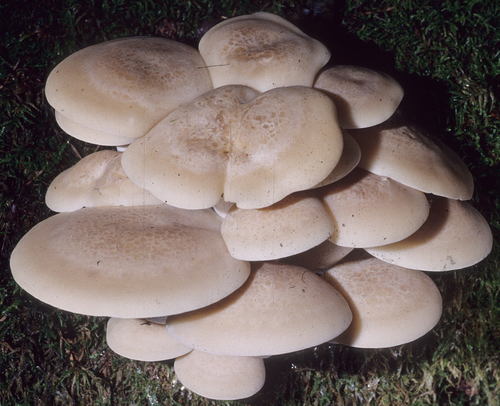
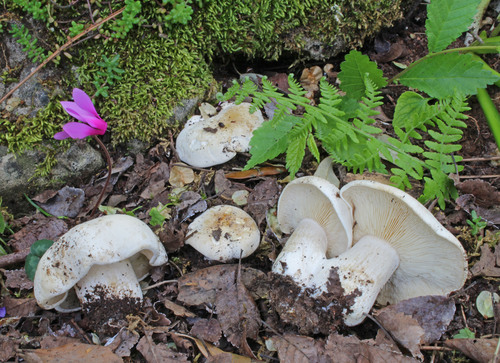
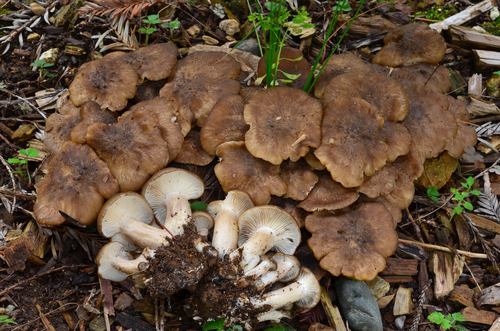
The fungus Lyophyllum decastes (Fr.) Singer has smooth caps that vary in color, measuring 4–12 cm (1+1⁄2–4+3⁄4 in) wide. Its whitish-grayish stalks are 5–10 cm (2–4 in) long and 1–3 cm (3⁄8–1+1⁄8 in) wide. The gills are white, but may develop a slight yellow tint as the mushroom ages. Its firm flesh stays white when exposed to air, and its spores are white. This species was first described from Sweden, and is widespread across Europe and north temperate regions. It grows abundantly from summer and fall through to spring on the West Coast of the United States, and is widely distributed across the whole of North America. It also grows in eastern temperate Asia. Lyophyllum decastes typically grows in dense, often very large clusters on the ground. It is usually found in areas of disturbed ground, including roadbeds, gravel areas, paths, and landscaping sites, and sometimes grows in woodland. It has been classified either as saprotrophic or ectomycorrhizal. In North America, Lyophyllum decastes is considered edible and is sometimes collected from the wild, though there are reported cases of gastric upset after consumption. It can also be mistaken for poisonous species such as Entoloma species or Clitocybe dilatata. This fungus is commercially cultivated in Japan, where it is called hatake shimeji, and in China, where it is called luronggu. It is grown on sawdust or bark compost, and used both as food and as a health supplement.