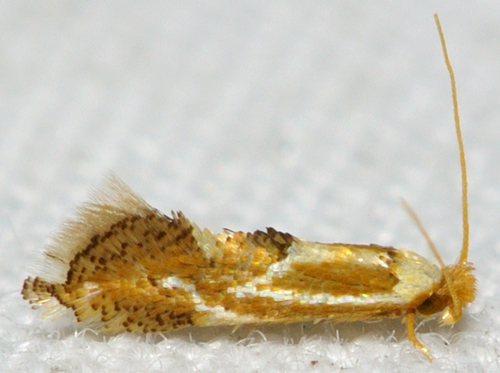
About Lyonetia prunifoliella (Hübner, 1796)
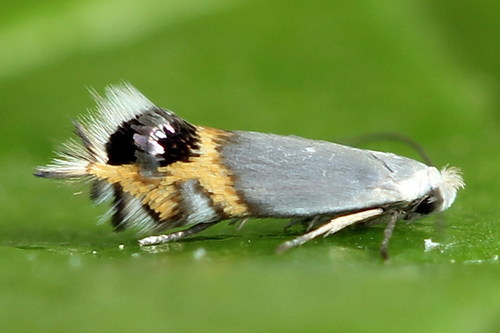
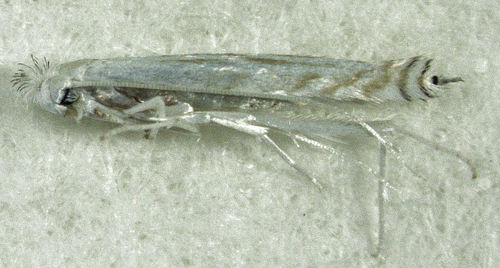
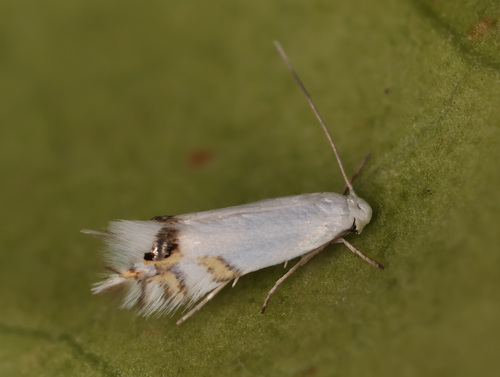
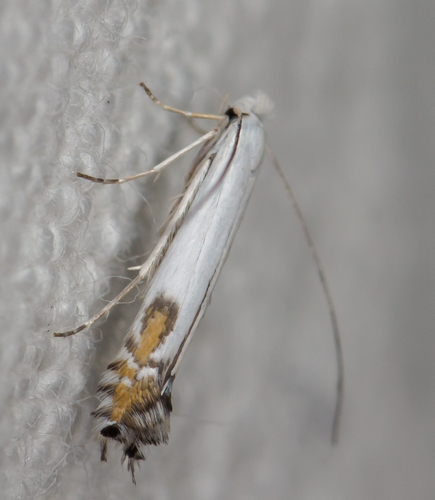
This moth species has a wingspan of 9–10 mm. Adult moths become active in September, overwinter, and emerge again in the spring. The larvae feed on a range of host plants, including Betula pendula, Betula pubescens, Chaenomeles japonica, Cotoneaster integerrimus, Crataegus monogyna, Cydonia oblonga, Mespilus germanica, Prunus armeniaca, Prunus cerasifera, Prunus dulcis, Prunus mahaleb, Prunus persica, Prunus spinosa, Pyrus communis, and various Sorbus species. Larvae create mines inside the leaves of their host plants. Eggs are laid on the underside of a leaf. A cavity forms around the egg-laying site, which often leaves a hole in the leaf by the end of development. The mine begins as a narrow, winding corridor that barely widens, and is mostly filled with a broad reddish-brown frass line. The corridor then expands into a wide, full-depth blotch that is often located against the leaf margin. A larva may leave its existing mine and start a new mine, sometimes on a different leaf. This species occurs across most of Europe, excluding Ireland, the Iberian Peninsula, and the Mediterranean islands. It was thought to be extinct in Great Britain, but has been recorded in the region recently. It is also found in Turkey, Kazakhstan, south-eastern Siberia, the Far East, Japan, and North America.