About Lymnocryptes minimus (Brünnich, 1764)
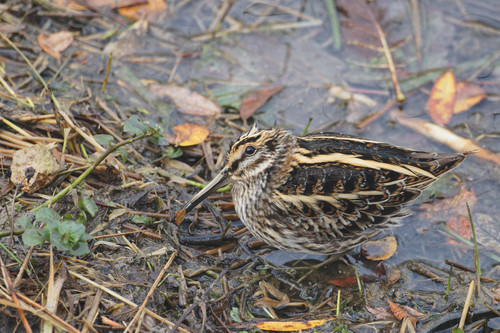
Adults of Lymnocryptes minimus, commonly called jack snipe, are smaller than common snipes and have relatively shorter bills. This species measures 18–25 cm (7.1–9.8 in) in length, has a wingspan of 30–41 cm (12–16 in), and weighs 33–73 g (1.2–2.6 oz). Its upper body is mottled brown, and its underbody is pale. Jack snipes have a dark stripe running through the eye. They have pointed, narrow wings, and yellow back stripes are visible when the bird is in flight. When observed, jack snipes have a distinctive bobbing movement that looks as if the bird is moving on springs, and this movement has an almost hypnotic quality. The head pattern of the jack snipe differs from that of the common snipe and other species in the genus Gallinago: jack snipes do not have a central crown-stripe, and instead have two pale lateral crown-stripes. These pale stripes are separated from the supercilium by an area of dark plumage. Jack snipes are migratory birds. They spend the non-breeding season in Great Britain, Atlantic and Mediterranean coastal Europe, Africa, and India. This species is one of the species covered by the Agreement on the Conservation of African-Eurasian Migratory Waterbirds (AEWA). Their breeding habitat consists of marshes, bogs, tundra, and wet meadows with short vegetation located in northern Europe and northern Russia. Jack snipes are rare vagrants in North America, and there is also one recorded sighting from Colombia in South America.