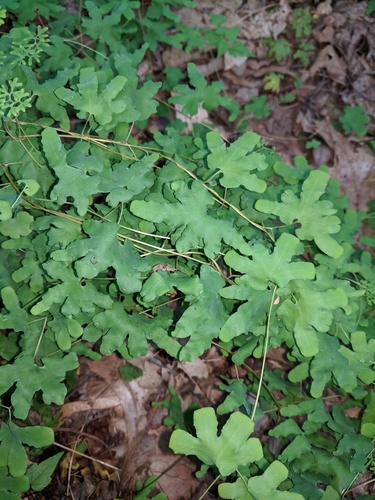
About Lygodium palmatum (Bernh.) Sw.
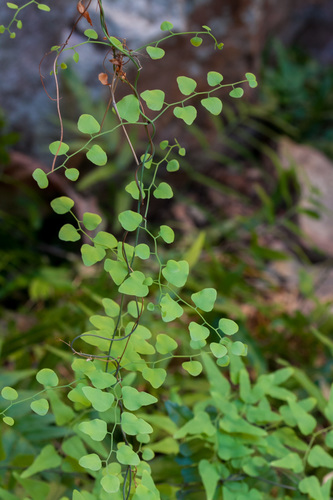
Lygodium palmatum (Bernh.) Sw., commonly known as American climbing fern, Hartford fern (named for Hartford, Connecticut), or Alice's fern, is the only species of its genus native to North America. Unlike most species in the Lygodium genus, it is extremely hardy in temperate zones. Two other temperate-tolerant species in the genus are New Zealand's Lygodium articulatum and Japanese Lygodium japonicum, which is now highly invasive in Florida. The name "Hartford fern" comes from the species' former common occurrence in Hartford and the surrounding region of Connecticut. Early settlers used this fern extensively for Christmas decorations, a practice that led to the passage of the first law protecting a plant species in the United States in 1869. Today, Lygodium palmatum appears on endangered or threatened species lists in several U.S. states. To thrive, it requires constant moisture, high light levels, and strongly acidic soil. Where these conditions are met, it grows in large quantities, resulting in a distribution pattern of abundant but rare, localized populations across its range. Its range is primarily Appalachian, extending from New England south through the Appalachians, Piedmont, and Appalachian plateaus into the southern United States. Like other rare Lygodium species such as Lygodium articulatum, Lygodium palmatum spores have relatively low viability. Even immediately sown spores have a germination rate of less than 50%, and spores sown after six months of storage have a germination rate of less than 5%.