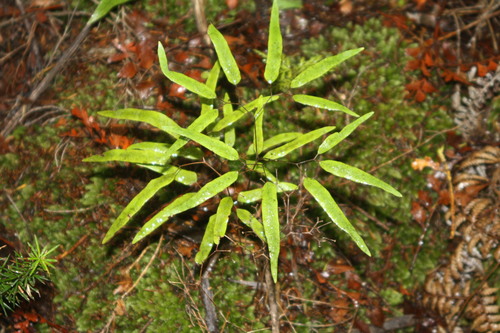
About Lygodium articulatum A.Rich.
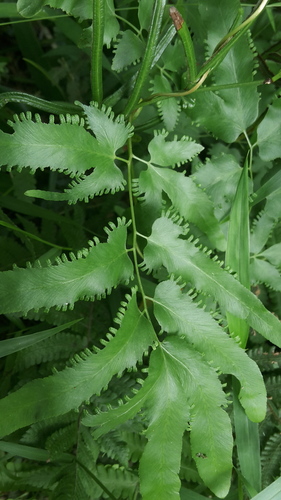
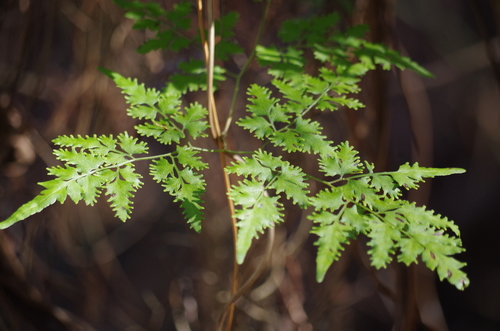
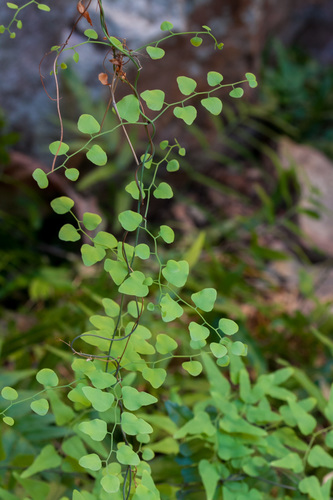
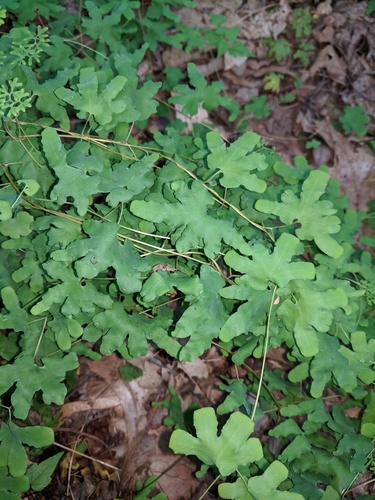
Lygodium articulatum, commonly called mangemange, has roots that grow laterally from its stem, which is also known as a rhizome. Its rhizomes are hairy and long-creeping, producing fronds that are widely spaced apart. Fronds grow alternately from the stem, forming twisted, climbing dichotomous costae that wrap around nearby branches or trees for support. Once the plant is supported by a branch, stipes and pinnae develop. Mangemange produces two types of pinnae: sterile vegetative pinnae that reach 10 cm (3.9 in) long, and fertile pinnae that reach 1 cm (0.39 in) long. Sterile pinnae are flat and smooth, while fertile pinnae are wrinkled and fan-shaped, ending in spore structures that release yellow spore dust when mature. This fern often grows rapidly to 3 metres (9.8 ft) high up trees, where it can form a wall or curtain of leaves and twiggy vines. The strength of its rhizomes makes thick growths of this plant difficult to navigate through. This climbing, mat-forming growth habit is common to the genus Lygodium, and has helped many members of the genus become widely successful. A well-known example is Lygodium japonicum, which forms similar dense vertical mats and is currently highly invasive and damaging in Northern Florida. Mangemange is primarily found on the North Island of New Zealand, specifically in the Northland, Auckland, Volcanic Plateau, Gisborne, and Taranaki regions. It grows at elevations ranging from sea level to 950 metres (3,120 ft). As a climbing fern that relies on neighboring structures for growth, its habitat is centered around areas where other species grow: it occurs most often in manuka and kanuka scrub, and in kauri, podocarp, and broadleaved forest. The vine-like curtain of growth that mangemange forms in the forest canopy makes it unique among other local ferns. While most of the plant’s mass is located in the surrounding forest canopy, its roots and stem grow from the ground, so it cannot be classified as an epiphyte. In Māori culture, the durable stems of mangemange are used as a binding material for constructions such as whare, and to build items like hīnaki (eel traps). It was also used in traditional burial customs to fasten bodies to trees before interment. The plant features frequently in traditional Māori stories, where it is used as a material to trap taniwha. It has uses in traditional rongoā Māori medicinal practices: infusions of its fronds are used as a remedy for toothache. Dried leaves of mangemange could also be used to secure a diaper, and the whole plant could be used to make a makeshift bed in the bush. The plant’s strong stems are also useful in Māori stone crafting, as they are tough enough to saw through pounamu.