About Lycorma meliae Kato, 1929
Lycorma meliae Kato, 1929 is a planthopper species first described in 1929. Males of this species have a body length between 22.2 millimetres (0.87 in) and 28.5 millimetres (1.12 in), while females are larger, with body lengths ranging from 26.5 millimetres (1.04 in) to 32.2 millimetres (1.27 in). Male forewing (also called tegmen) length ranges from 18.9 millimetres (0.74 in) to 25 millimetres (0.98 in), and female forewing length ranges from 23.2 millimetres (0.91 in) to 27.8 millimetres (1.09 in).
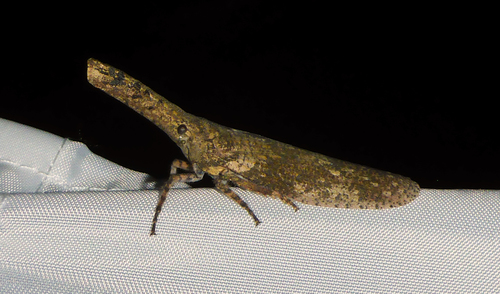
The head of Lycorma meliae is short, broad, and angled upward, and its color ranges from brown to black. Two dark brown projections sit on the back of the head, each with a ridge running down its back, and two additional longitudinal ridges run down each side of these projections. The clypeus is broad, and the labium, a mouthpart, is long but does not extend as far as the abdomen. The antennae are marigold orange-yellow. The prothorax, mesonotum, and abdomen are all black, though the margins of the abdominal tergites are sometimes marigold orange-yellow.
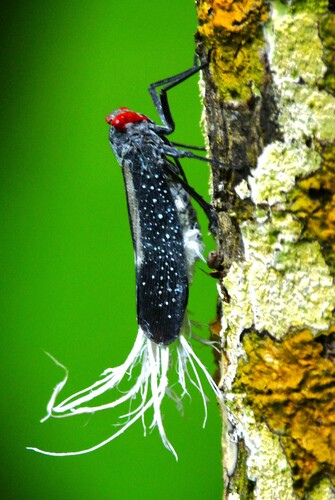
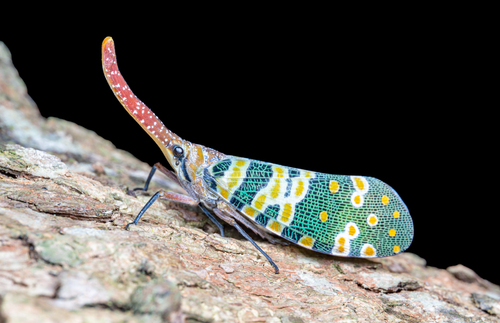
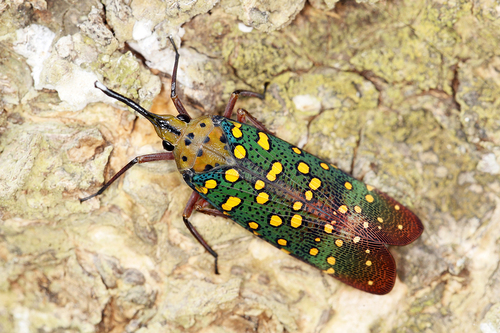
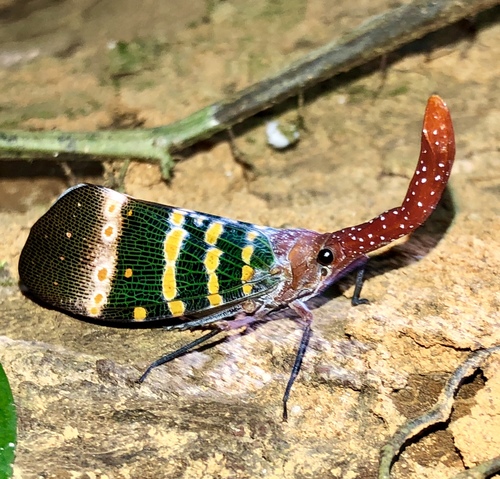
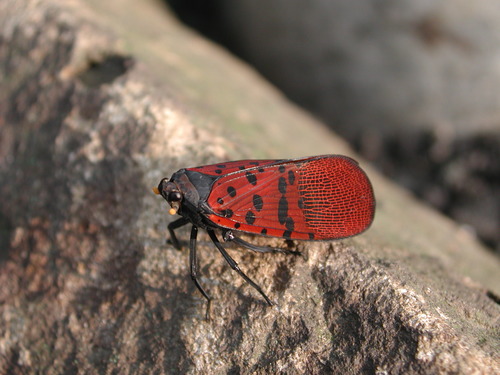
The basal three-fifths of the forewings ranges in color from bright red to blue. This section of the forewing is covered in black and brown spots of varying sizes, and sometimes has a white powdery texture. The remaining portion of the forewing is covered in a reticulate vein pattern. The hindwings vary in color from pink to light blue, and often have brown spots, with the basal third of the hindwings being brown. Legs are generally dark brown to black.
As individuals mature, their forewings go through a predictable series of color changes. They start out bright red with black spots, then transition through reddish brown, brown, and deep green, finally ending at dark blue. Over this process, the spots gradually change color from black to white.
Male genitalia of this species is formed by the 9th, 10th, and 11th abdominal segments. On the 9th segment, the anterior margin is concave, and the margins bear a series of small projections. The 10th segment is moderately convex, with its apical section broader than its basal section. This structure forms a V shape when viewed from the side and a U shape when viewed from above. The 11th segment consists of a sternite that is approximately twice the size of the tergite; this segment is oval-shaped, with hooks on its lateral margins. During mating, the lobes can expand to five times their sheathed length, folding backwards and downwards.
L. meliae is similar in appearance to Lycorma delicatula, and has sometimes been misidentified as that species. The two can be told apart by differences in coloration and eye structure. Lycorma meliae is endemic to the island of Taiwan. It is a hemimetabolous species, meaning it goes through nymphal stages before reaching adulthood, rather than having distinct larval and pupal stages. This species lays egg clusters coated in a waxy layer during late fall to early winter. Eggs develop until late spring, when nymphs emerge. Nymphs go through four instar stages before maturing into adults. The chinaberry tree, Melia azedarach, is a recorded host plant for L. meliae. All members of the genus Lycorma, including L. meliae, are parasitized by the eupelmid wasp Anastatus orientalis and the dryinid wasp Dryinus sinicus.