About Lycorma delicatula (White, 1845)
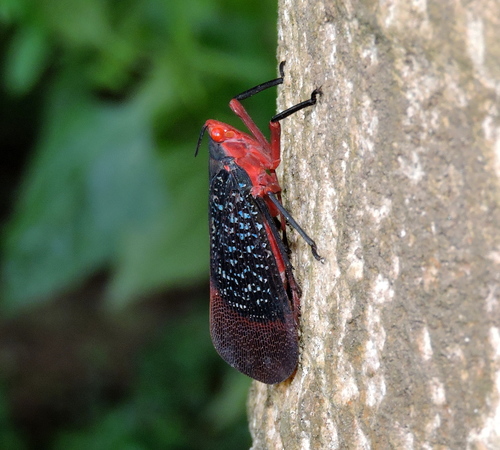
Adults of Lycorma delicatula, the spotted lanternfly, measure around 25 millimetres (1 in) long and 12 millimetres (1⁄2 in) wide. Adult lanternflies have a black head and gray-brown forewings marked with black spots. The original species description by White noted that L. delicatula has at minimum 20 black spots, with six spots on the anterior margin of the forewings. When the insect rests, its crimson hind wings are partially visible through the semi-translucent forewings, giving the lanternfly a faint red tint. The tips of the forewings have evenly spaced black rectangular markings, a pattern that is sometimes compared to brick and mortar. In flight, the spotted lanternfly shows red hind wings with black spots on the proximal third, a white wedge in the center of the wing, and a solid black wing tip. Its abdomen is yellowish, with black and white bands on both the top and bottom. L. delicatula has orange, bulbous antennae that end in needle-like tips. The spotted lanternfly is sexually dimorphic. Females have a set of red valvifers at the distal end of the abdomen that males do not have. When mated and gravid, the females' abdomens swell enough that they struggle to move. When measured from head to wing tip, adult females have a body length of 20 to 27 millimetres (13⁄16 to 1+1⁄16 in), while males are smaller, ranging between 21 and 22 millimetres (53⁄64 and 55⁄64 in) in length. Females also have longer legs than males. As a planthopper, the spotted lanternfly uses its wings to assist jumping rather than making sustained flights. When jumping, the spotted lanternfly performs a series of successive collisions as it falls, using both passive and active righting. This bouncing gives nymphs, and to a lesser degree adults, multiple chances to reorient themselves after a jump. The species also uses aerial reorientation and terrestrial righting to right itself, allowing it to land on a variety of surfaces and spread quickly through an environment. The spotted lanternfly is native to subtropical regions of Southeast Asia. Fossil evidence shows L. delicatula evolved between 55 and 51.6 million years ago, during the Ypresian Era. Phylogenomic analysis indicates the species originally evolved in southwest China, where it eventually diverged into six phylogeographic lineages. During the late Pleistocene Era, one of these lineages moved northward along the Yangtze River. By the 1930s, L. delicatula was known to live in the Northern Chinese provinces of Shanxi, Shandong and Hebei. Since that time, it has expanded its range in China to include Anhui, Beijing, Guangdong, Henan, Jiangsu, Sichuan, Yunnan and Zhejiang. In traditional Chinese medicine, the spotted lanternfly is considered poisonous, and has been used since the 1100s as a topical treatment to relieve swelling. The species has also been reported in Taiwan, Vietnam, and India, but ongoing research has not yet confirmed whether L. delicatula is native to these areas. Nymphs typically hatch from egg cases starting in late April or early May, which begins the lanternfly's developmental cycle. A nymph goes through multiple immature stages, all of which are wingless. The first instar is black with white spots. Later instars have red patches in addition to the white spots. The final nymphal instar has red wing pads and a red upper body, before molting into the adult form with a black head and grayish wings with black spots. Nymphs hop or crawl to find plants to feed on. Young nymphs (first through third instars) appear to have a wider host range early in development, which narrows as they grow older. While lanternflies have been recorded feeding on several herbaceous plants, this is most likely an effect of early-instar nymphs climbing or falling onto these plants; late-instar nymphs and adult lanternflies have no consistent association with herbaceous plants. Adults can appear as early as July, and they mate and lay eggs from late September through the start of winter. During mating periods, spotted lanternflies undertake migratory flights. During these migrations, adult L. delicatula complete a brief courtship followed by copulation that can last up to 4 hours. In its native Indomalayan habitat, the spotted lanternfly prefers to lay its eggs on tree of heaven (Ailanthus altissima), which is a poisonous invasive species. Researchers think this host preference evolved as a way to protect the species from natural enemies. L. delicatula can reproduce using other host plants besides A. altissima, but it generally cannot build up large populations unless A. altissima is present. Multiple hypotheses have been proposed to explain why L. delicatula prefers to feed on certain plants, and two currently investigated possible factors are the total sugar composition of the plant and the presence of toxic chemicals. The lanternfly lays eggs on any smooth-trunked tree, stone, or vertical smooth surface, including human-made items such as vehicles, yard furniture, and farm equipment, as well as other items stored outdoors. Egg masses hold 30 to 50 eggs, covered in a yellowish-brown waxy deposit called an egg case. L. delicatula eggs enter diapause during embryonic development, and require two weeks of warm temperatures after winter before hatching is triggered. Eggs that have overwintered for five months or longer have higher hatch rates and more synchronous hatching, which indicates cold temperatures increase overall egg survival. Most adults die by the end of December. Multiple studies have tested how overwintering affects L. delicatula eggs. Based on mean daily temperatures from the 2009–2010 winter, South Korean researchers estimated the maximum cold temperature that still kills eggs to be between −12.7 and −3.4 °C (9.1 and 25.9 °F). This estimate conflicts with observations of eggs surviving much colder temperatures in the 2013–2014 winter in Pennsylvania, United States. Another study conducted at Rutgers University found that at −25 °C (−13 °F) no eggs hatch, while at −15 °C (5 °F) limited hatching still occurs, with outcomes depending on how long eggs were chilled and where they were stored.