About Lycopodium clavatum L.
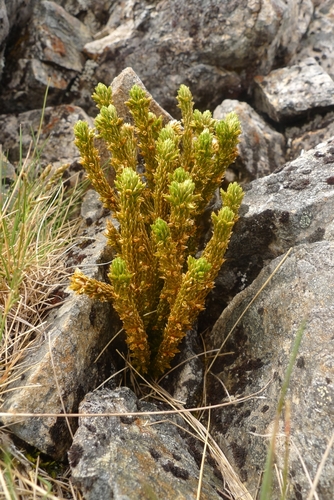
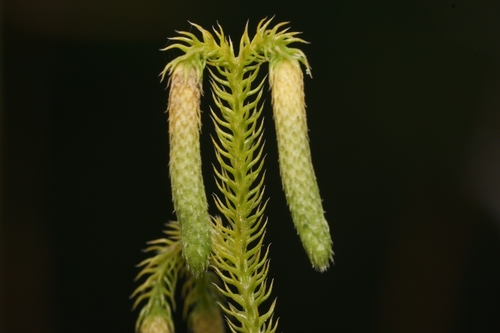
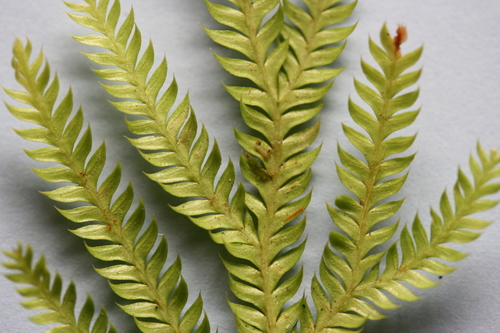
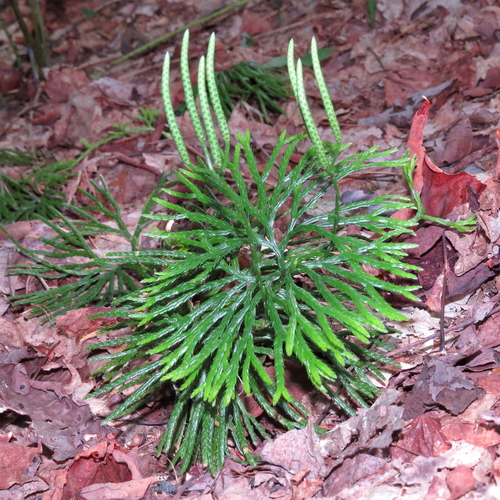
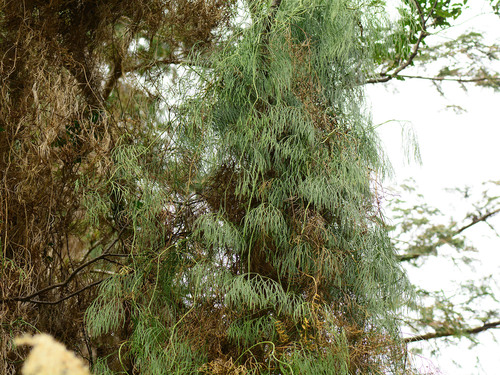
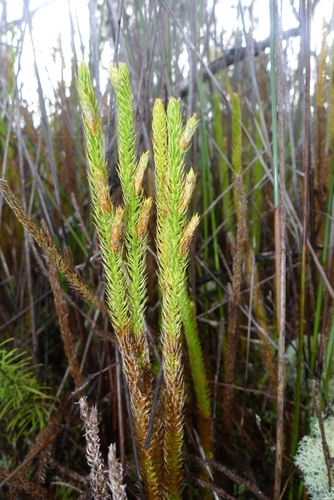
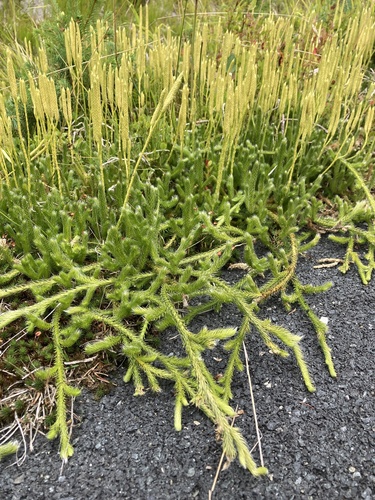
Lycopodium clavatum L. is a spore-bearing vascular plant. It grows mostly prostrate along the ground, with stems that reach up to 1 metre (39 inches) long. These stems are heavily branched and densely covered with small, spirally arranged microphyll leaves. Each leaf measures 3–5 mm long and 0.7–1 mm broad, tapering to a fine, hair-like white point. Branches that hold strobili (also called spore cones) grow erect, reaching 5–15 cm (2.0–5.9 in) above ground, and their leaves are modified into sporophylls that enclose the spore capsules, called sporangia. The spore cones are yellow-green, 2–3 cm (0.79–1.18 in) long, and 5 mm (0.20 in) broad. Horizontal stems grow dichotomous roots at frequent intervals along their length, which lets the stem grow indefinitely along the ground. The stems look superficially similar to small conifer tree seedlings, though the species is not related to conifers at all. Lycopodium clavatum has a widespread distribution across multiple continents, with distinct subspecies and varieties native to different regions of its range. These taxa are: Lycopodium clavatum subsp. clavatum var. clavatum, found in Europe, Asia, and North America; Lycopodium clavatum subsp. clavatum var. aristatum, found in Mexico, the Caribbean, Central America, and northern South America as far south as northern Argentina; Lycopodium clavatum subsp. clavatum var. asiaticum, found in Japan and northeast China; Lycopodium clavatum subsp. clavatum var. borbonicum, found in central and southern Africa; Lycopodium clavatum subsp. clavatum var. kiboanum, found in the mountains of tropical Africa; and Lycopodium clavatum subsp. contiguum, found in southern Central America and northern South America, which is also synonymized as Lycopodium contiguum. Despite being globally widespread, this species, like many other clubmosses, is restricted to undisturbed sites, and disappears from farmed areas and sites that experience regular burning. Because of this, it is endangered in many regions. In the UK, it is counted among the 101 species designated as high priority for conservation by the wild plant charity Plantlife. Common names for this species include wolf's-foot clubmoss, common clubmoss, wolf-paw clubmoss, running ground-pine, running pine, running moss, and princess pine, among others. Dried spores of this plant are explosive when present at high density in air. These spores were used as flash powder in early photography, and they are still used in stage magic acts; the spores are widely known as lycopodium powder. This plant has been used in Finnish traditional medicine as a diuretic and as a treatment for rickets. Bioactive secondary metabolites isolated from this clubmoss species include triterpenoids that have acetylcholinesterase inhibitor activity.