About Lycoperdon umbrinum Pers.
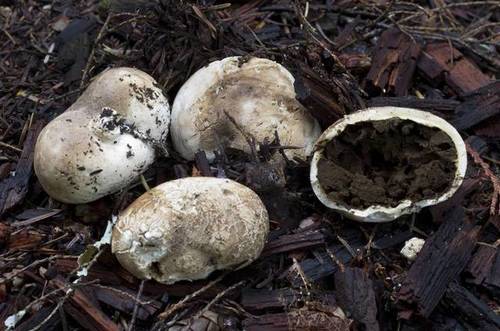
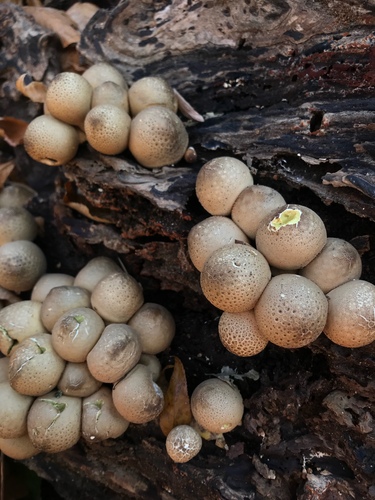
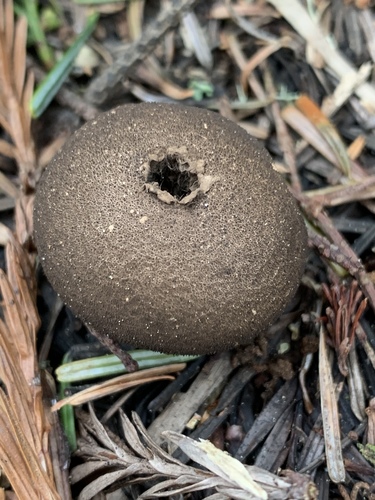
Lycoperdon umbrinum Pers. produces top-shaped fruit bodies with a short, partially buried stipe. Fruit bodies measure 2 to 5 cm (0.8 to 2.0 in) tall and 1 to 4 cm (0.4 to 1.6 in) broad; they are roughly the size of a golf ball, though they can grow as large as a tennis ball. This species is very similar to Lycoperdon molle, with two key distinguishing differences: the spines on L. umbrinum are sparser, and L. molle has much larger spores. L. umbrinum spores are spherical, and are either smooth or ornamented with spines. In a KOH test, L. umbrinum spores appear olive-yellow. Additional spore characteristics include a diameter of 3.5–5.5 μm, fine warts, and a 0.5–15 μm long pedicel. The fruit body starts out pale brown, then darkens to reddish to blackish brown. Its outer wall holds slender, persistent spines that can reach up to 1 mm long. This species is uncommon, and occurs mostly in coniferous woods growing on sandy soil. It is saprophytic, and commonly grows in forests under conifers; it has also been observed growing in low-quality soil in mixed areas with both hardwood and conifer trees. Fruit bodies can grow singly, scattered across an area, or clustered in large groups. Its fruiting period runs from June through September. Unlike gilled agarics that hold spores on gills, L. umbrinum releases spores when it dries out and bursts under the right conditions. One study conducted in large-scale conifer plantations in South Africa found that L. umbrinum likely forms a mycorrhizal mutualism with Pinus patula: the two species often grow close together, and branched, finger-like mycorrhizae develop beneath L. umbrinum fruiting bodies. Lycoperdon umbrinum is edible, but foragers must use caution when collecting it, as it can be confused with toxic earth balls or deadly Amanita species. This species has documented medicinal uses. The Mam ethnic group of Mexico historically uses this mushroom, which they call "wutz anim" or "dead's eye", to ward off the evil eye. They typically prepare it by boiling, and eat it alone or with other plants. The group also uses it to treat asthma, by making a powder mixed with other plants, and it has uses that overlap with those of baby powder. In some regions of Mexico, whole families participate in mushroom gathering traditions that include collecting L. umbrinum for food, medicine, religious purposes, or sale. Laboratory studies have found that L. umbrinum has significant antibacterial properties, and potential antimicrobial properties. The endophytic fungus Aspergillus tamarii forms a mutualistic association with L. umbrinum. Extracts of A. tamarii taken from L. umbrinum show significant antibacterial activity against Salmonella typhi, Staphylococcus aureus, Bacillus subtilis, and Escherichia coli. L. umbrinum itself also shows antimicrobial activity against methicillin-resistant Staphylococcus aureus (MRSA); in one study, L. umbrinum and Trametes versicolor inhibited MRSA growth more effectively than any other tested fungi, suggesting these species could be a new source of antimicrobial compounds to treat MRSA. Despite its potential beneficial antimicrobial and antibacterial properties, inhalation of L. umbrinum spores should be avoided. Inhalation (or ingestion) of puffball spores from Lycoperdon species can cause lycoperdonosis, a condition that leads to unpleasant symptoms.