About Lycoperdon perlatum Pers.
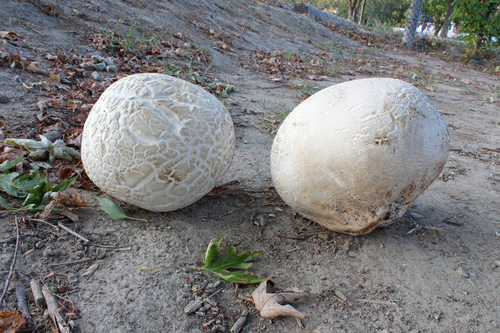
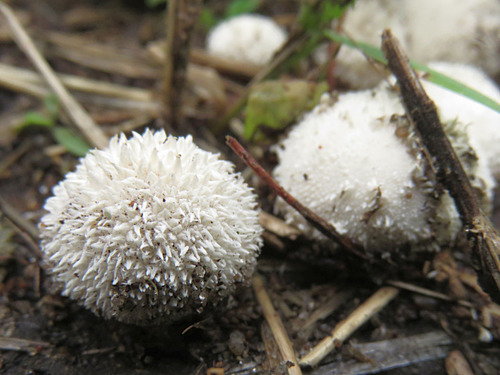
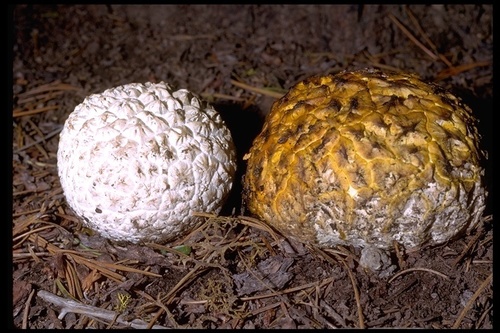
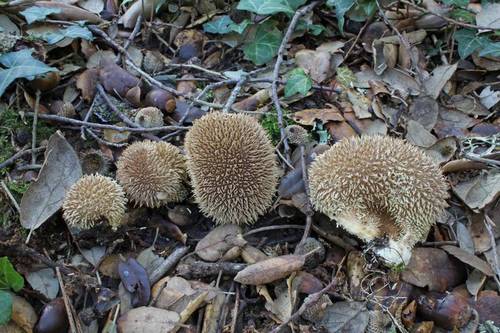
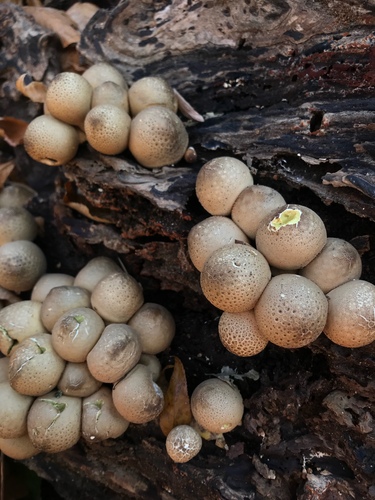
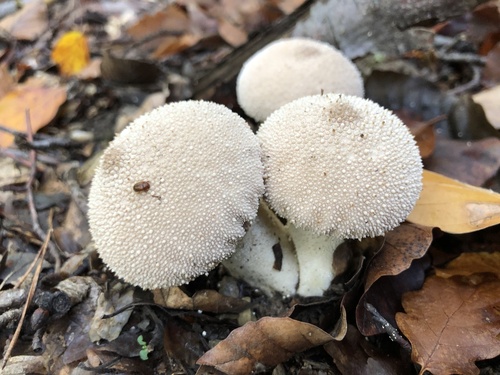
Lycoperdon perlatum Pers. is a common puffball fungus. Its fruit body ranges in shape from pear-like with a flattened top to nearly spherical, reaching 1.5 to 6 cm wide by 3 to 9 cm tall. It has a thick, stem-like base, and is whitish when young before browning with age. The outer surface (exoperidium) is covered in short cone-shaped spines interspersed with granular warts; these spines, which can be whitish, gray, or brown, are easily rubbed off, leaving reticulate pock marks or scars after removal. The base, which starts white and turns yellow, olive, or brownish with age, shows a less distinct reticulate pattern from rubbed-off spines. When mature, the exoperidium at the top of the puffball sloughs away, revealing a pre-formed opening (ostiole) in the inner endoperidium that allows spores to escape. In young puffballs, the internal spore-bearing tissue (called the gleba) is white and firm, turning brown and powdery as spores mature. The young gleba contains small chambers lined with the fertile hymenium tissue; these chambers collapse once spores mature. Mature puffballs release their powdery spores through the ostiole when compressed by touch or falling raindrops. A study of spore release in the closely related Lycoperdon pyriforme using high-speed schlieren photography found that raindrops 1 mm in diameter or larger (including drips falling from nearby trees) are enough to trigger spore discharge. Spores are ejected from the ostiole at around 100 cm per second, forming a centimeter-tall cloud one-hundredth of a second after impact, and a single discharge can release over a million spores. The spores of Lycoperdon perlatum are spherical, thick-walled, covered with minute spines, and measure 3.5–4.5 μm in diameter. Capillitia, the threadlike filaments that hold spores within the gleba, are yellow-brown to brownish, lack septa, and measure 3–7.5 μm in diameter. Spore-bearing basidia are club-shaped, four-spored, and measure 7–9 by 4–5 μm, each bearing four slender sterigmata of unequal length between 5–10 μm long. The surface spines are formed from chains of pseudoparenchymatous hyphae that resemble the parenchyma of higher plants. Individual hyphal cells here are spherical to elliptical, thick-walled (up to 1 μm thick), measure 13–40 by 9–35 μm, and do not have clamp connections. As a saprobic species, Lycoperdon perlatum grows singly, scattered, in groups or clusters on the ground, and can also grow in fairy rings. Its typical habitats include woods, grassy areas, and along roads; it has specifically been reported from Pinus patula plantations in Tamil Nadu, India. From a distance, the fungus sometimes resembles a golf ball, which can confuse golfers. Lycoperdon perlatum is a widespread species with an almost cosmopolitan distribution. It has been recorded from Africa (Kenya, Rwanda, Tanzania), Asia (China, Himalayas, Japan, southern India, Iran), Australia, Europe, New Zealand, South America (Brazil), subarctic Greenland, and subalpine Iceland. In North America, where it is considered the most common puffball species, it ranges from Alaska to Mexico, and is less common in Central America. This puffball bioaccumulates heavy metals from soil, so it can be used as a bioindicator for soil pollution by heavy metals and selenium. A 1977 study found high concentrations of cadmium and lead in L. perlatum samples collected from grassy areas beside an interstate highway in Connecticut, USA. Experimental studies have shown that L. perlatum biomass can remove mercury ions from aqueous solutions, and the species is being investigated for potential use as a low-cost, renewable biosorptive material to treat water and wastewater contaminated with mercury.