About Lycoperdon echinatum Pers.
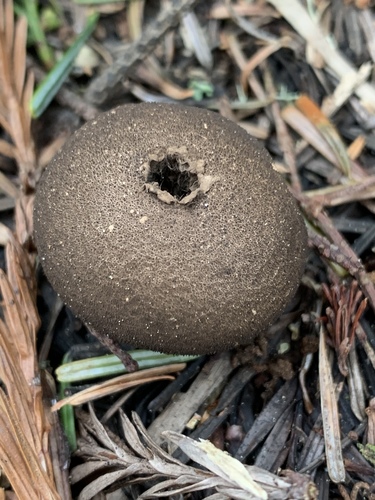
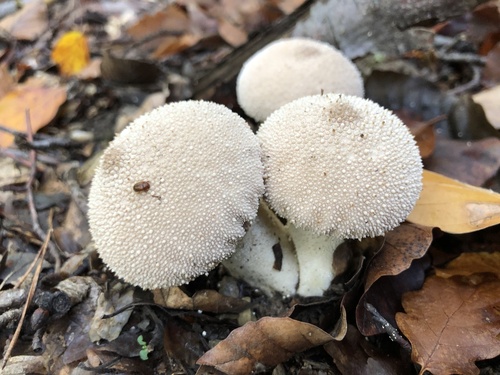
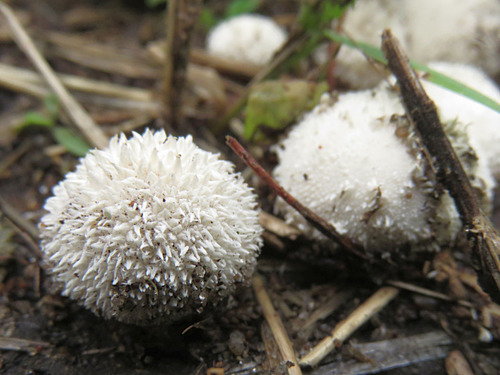
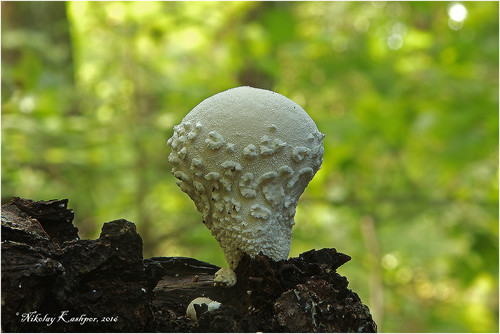
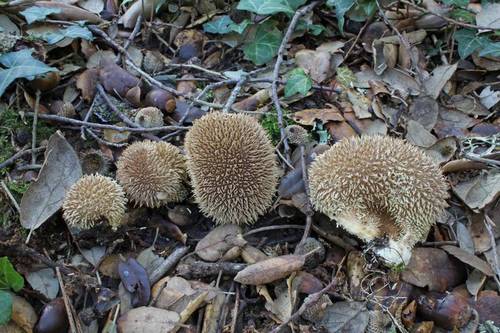
The fruit bodies of Lycoperdon echinatum are 2–4 cm (0.8–1.6 in) wide by 2–3.5 cm (0.8–1.4 in) tall, and are roughly spherical or pear-shaped. The exterior surface is covered densely with spines that can grow up to 0.6 cm (0.2 in) long. Naturalist Curtis Gates Lloyd notes that American specimens have more slender spines than European specimens. When young, the spines are white, turning dark brown as they mature, and often join together at the tips in groups of three or four. In this clustered spine form, the puffballs resemble the acorn caps of burr oak, and can be easily confused with them. As the puffball ages, the spines fall off, exposing a somewhat net-like or reticulated surface underneath. The fruit body has a small off-white or purple-gray base, and may attach to the surface it grows on via thin white cords called rhizomorphs. The internal contents of the puffball hold the gleba, a mass of spores and associated spore-producing cells. In young specimens the gleba is white and firm, but as the puffball ages, it turns yellowish, then becomes brown to purple-brown and powdery. Mature specimens develop a pore at the top of the fruit body; spores are released through this pore when falling raindrops strike the puffball. The spores of Lycoperdon echinatum are roughly spherical with warts on their surface, and have diameters between 4 and 6 μm. The capillitia, which are coarse thick-walled hyphae located in the gleba, are elastic, brown in color, have small pores, and are 5–8 μm thick. The basidia, the spore-bearing cells, may attach to two to four spores, and the sterigmata, the tapered spine-like projections from the basidia that hold the spores, are up to 5 μm long. Lycoperdon echinatum can be found growing either solitary or in small groups. It typically grows on the ground in deciduous forests, grassy areas, glades, and pastures, growing on moss, humus, or woody debris. The fungus is noted to prefer growing in beech woods. Fruit bodies can appear any time from late spring to autumn. Older specimens are more likely to be overlooked, as their brown color blends into the surrounding environment of dead leaves and dead wood. Various species of scuttle flies (family Phoridae) use this puffball as larval food. This species has been collected from eastern central Africa, China, Costa Rica, Iran, Japan, and Europe, including Britain, Bulgaria, the Czech Republic, Finland, Germany, Italy, Slovakia, Spain, Sweden, and Switzerland. In North America, it is "locally frequent" east of the Rocky Mountains. It is classified as a threatened species in Åland, Finland. A study of the species' distribution in Sweden reported that in the 1940s and 1950s, it grew in beech woods alongside broad-leaved grasses and herbs in topsoils with soil pH levels between 5.0 and 6.6, but populations have decreased since that time due to soil acidification over the last several decades. Fruit bodies collected near arsenic-contaminated sites have been shown to bioaccumulate arsenic, mostly in the form of arsenobetaine.