About Lycodon ruhstrati (Fischer, 1886)
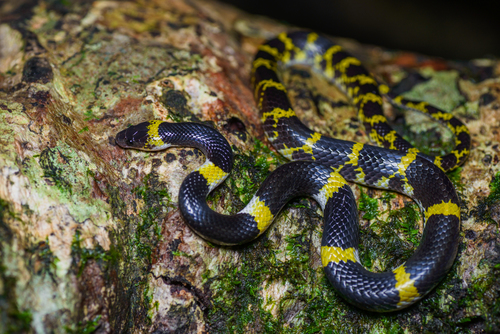
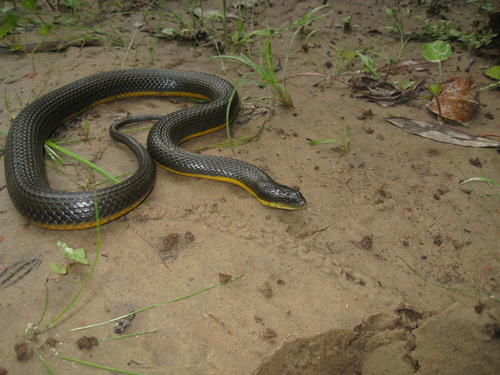
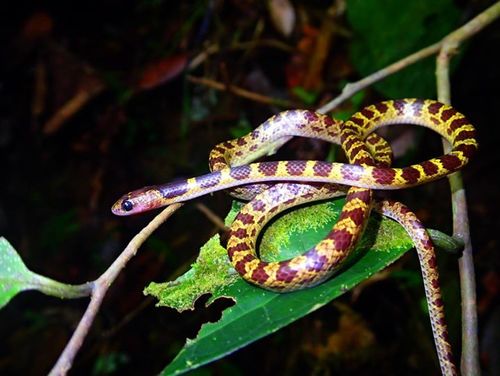
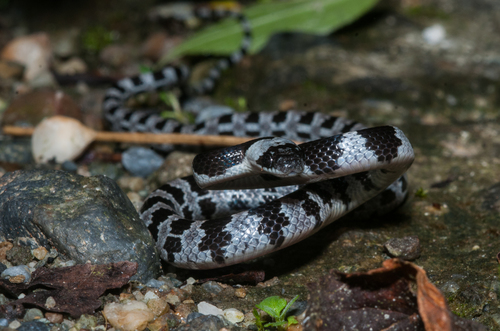
Lycodon ruhstrati, commonly known as Ruhstrat's wolf snake, has a highly variable color pattern. Individuals are typically dark-colored, with multiple light crossbands across the back. Before 2008, the largest known specimen had a total length including its tail of 94 cm (37 in). L. ruhstrati is an oviparous (egg-laying) species; females produce clutches of four eggs each. It is a montane snake that lives on slopes, in caves, and beneath stones in mountain streams. It can also be found in agricultural land, natural forests, and plantation forests in the foothills. This snake is known to prey on the brown anole Anolis sagrei and Diploderma swinhoni. Lycodon ruhstrati is distributed across the Tranninh Plateau of Laos, northern Vietnam, Taiwan, and southern China. Within southern China, it occurs in the provinces of Anhui, Fujian, Gansu, Guangdong, Guangxi, Guizhou, Jiangxi, Shaanxi, Sichuan, Zhejiang, and Hong Kong. The subspecies Lycodon ruhstrati multifasciatus was formerly recorded in Japan's Ryukyu Islands, but this taxon has since been reclassified as a separate species. The International Union for Conservation of Nature classifies L. ruhstrati as a species of Least Concern. This classification is based on the assumptions that the species has a large population, covers an extensive distribution range, is not declining at a rapid rate, and occurs within multiple protected areas. No species-specific conservation efforts are currently in place for this snake.