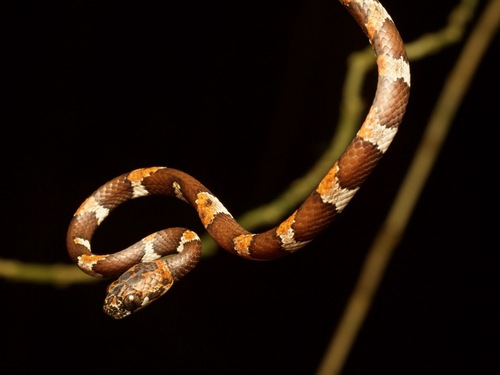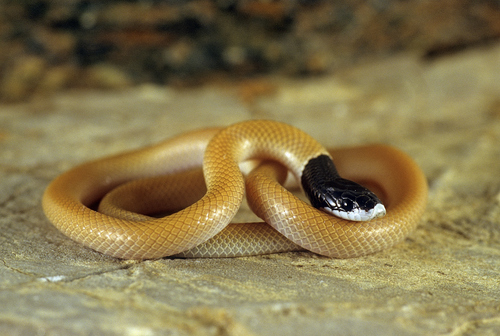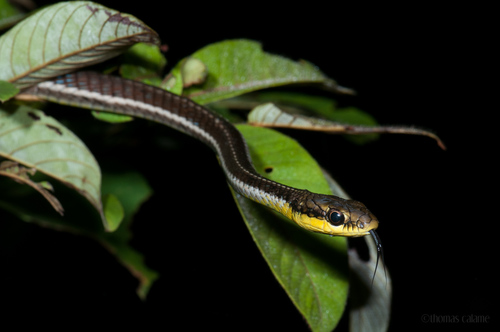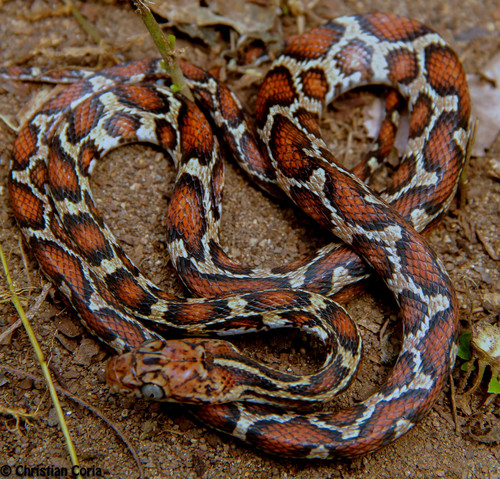
About Lycodon rufozonatus Cantor, 1842
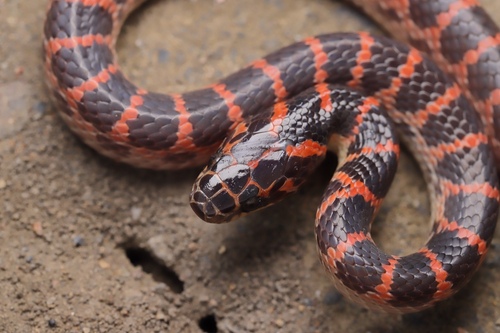
Lycodon rufozonatus Cantor, 1842 typically reaches a total length including tail of around 70 centimetres (28 in), with extreme individuals growing up to 130 cm (51 in). It has a long, relatively flat head that is somewhat distinct from the neck. Its medium-sized eyes bulge slightly and have vertical pupils. Ventral scales have a strong keel, while dorsal scales are only faintly keeled; the typical scale count is 17:17:15, but this can reach up to 21:19:17 in some individuals. This species occurs across a large portion of East Asia, ranging from the Korean Peninsula in the north (with its range extending just into easternmost Russia) to northern Laos and Vietnam in the south; most of its total range lies within eastern China. All continental populations belong to the nominate subspecies L. r. rufozonatus, while a second subspecies, L. r. walli, is native to the Ryukyu Archipelago of southern Japan. Lycodon rufozonatus occupies a wide diversity of habitats, occurring from near sea level up to 2,000 metres (6,600 ft) in elevation, and is most common near river plains. It is usually found on the ground, but is occasionally observed swimming in streams. It is a nocturnal species that preys on fish, frogs, lizards, other snakes, and young birds. This species generally has a mild temperament, curling into a spherical mass with its head hidden when approached. However, individual temperaments can be unpredictable, and some individuals will bite readily. There are very few published clinical reports about the toxinology of this species' bites, but it appears to be non-venomous. Lycodon rufozonatus can carry tapeworms from the genus Spirometra, and consumption of raw meat from this snake has caused cases of human sparganosis in Korea and Japan. Lycodon rufozonatus is oviparous.