About Lycium oxycarpum Dunal
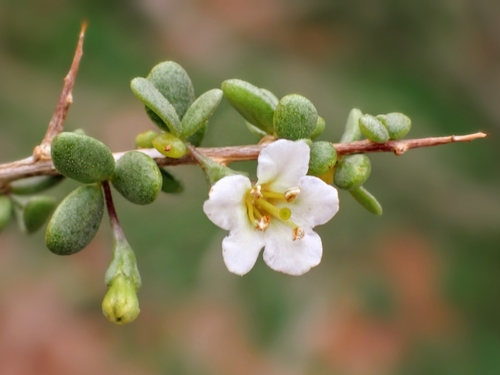
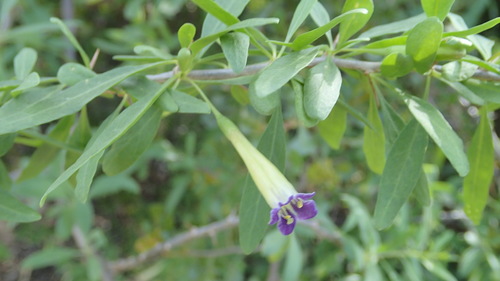
Lycium oxycarpum Dunal is a large shrub that, unlike many other species in the Lycium genus, can eventually grow into a small tree reaching a maximum height of 5 meters. It has curving branches, with younger branches being quite sturdy, which gives this species a distinctive look. Its branches are covered in short thorns that are roughly equal in length along each entire branch. While it shares these branch and thorn characteristics with its close relative Lycium bosciifolium, these traits still help distinguish Lycium oxycarpum from most of its other relatives in the genus. Like many other Lycium species, its leaves are oblong, narrowly-elliptic, or obovate in shape. The leaves are bright green, with a slightly lighter color on their undersides. Its flowers are mostly solitary and grow from leaf axils. The corolla has a long, funnel-shaped tube; it is cream-colored with longitudinal lines, and is tipped with small mauve lobes (petals). The calyx is small and only covers a small portion of the base of the flower tube. The flowers are the most distinctive feature of this species, and they distinguish it from all other Lycium species found in Africa. This species is native to the Western Cape, Northern Cape, Eastern Cape, and Free State provinces of South Africa, where it typically grows in inland dry karrooid areas, specifically the Great Karoo and Little Karoo regions. It also occurs in southwestern Angola.