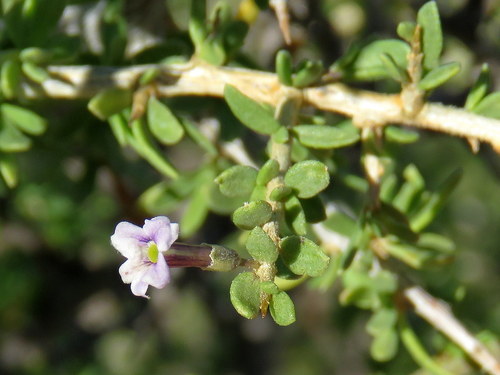
About Lycium horridum Thunb.
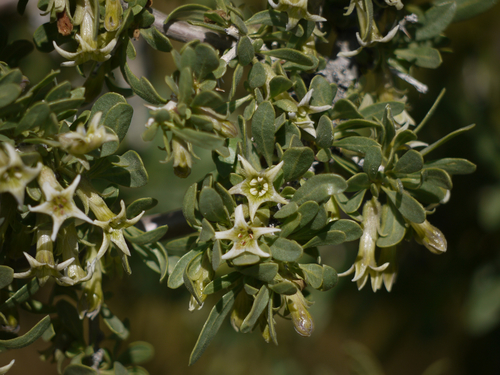
Lycium horridum is a rigid shrub that has stout thorns that gradually become shorter towards the stem tips. This gives the branches a somewhat tapering, conical appearance, a feature that can sometimes be used to identify the species. Young stems start out green and soft, then harden and turn white, usually marked with dark streaks. Older stems mature to a dark grey to brown colour. Like many other Lycium species, the leaves of L. horridum are oblong, narrowly elliptic, or linear in shape. They are succulent but flattened, and grow in clusters on inconspicuous brachyblasts. Flowers grow from the leaf axils. The corolla is small, white, and tubular, with five (sometimes four) spreading lobes (petals) that are much shorter than the corolla tube. The stamens extend only slightly out from the mouth of the corolla. The calyx is tubular, about twice as long as it is wide, and its shorter length means it covers less than half of the corolla tube. Unlike most African Lycium species, L. horridum is dioecious. Its fruits are small red berries, which are rounded to ovoid with a slightly pointed tip. The species is widespread across most of South Africa, with the exception of the eastern Lowveld and KwaZulu-Natal. It also grows in the southern parts of Namibia and Botswana.