About Lycium ferocissimum Miers
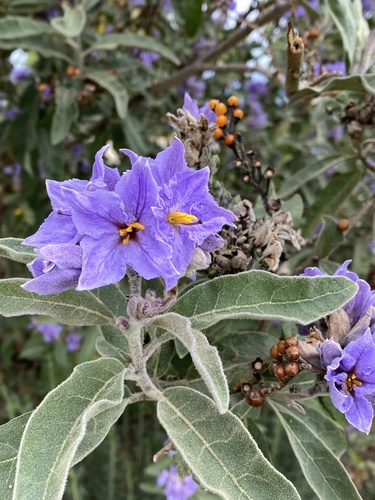
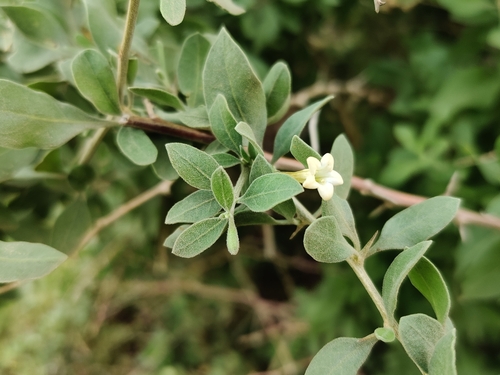
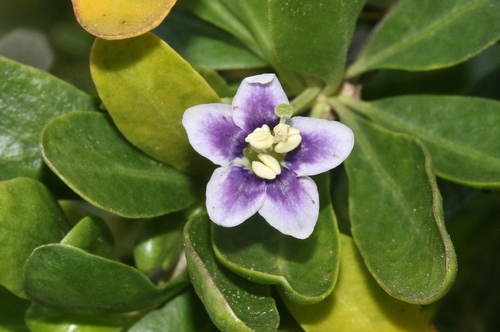
Lycium ferocissimum Miers, commonly known as African boxthorn, is a large spiny shrub that grows up to 5 metres (16 ft) high. Its spines occur at random varying lengths along branches, and unlike most other Lycium species (only Lycium amoenum is an exception), they are formed as stout 'peg-thorns'. The leaves are oval, measuring 10–40 millimetres (0.39–1.57 in) long and 4–10 millimetres (0.16–0.39 in) wide. The broadly obovate or elliptical shape of its leaves sets this species apart from many similar Lycium species, which typically have narrower leaves. Solitary flowers grow from the plant's leaf axils. The corolla is funnel-shaped, with large, reflexed, pale purple petal lobes. The calyx is tubular and encloses most of the corolla, a trait it shares with Lycium pumilum. This specific feature – a calyx that reaches at least two thirds the length of the corolla – distinguishes Lycium ferocissimum from many of its close relatives. The species was first formally described in 1854 by British botanist John Miers, in the Annals and Magazine of Natural History. Miers based his description on plant material collected from Uitenhage, South Africa. Lycium ferocissimum is native to the Western Cape and Eastern Cape provinces of South Africa, where it most often grows in sands along the southern coast. It has also been recorded in the Free State, though these occurrences are likely the result of human introduction. It has been widely introduced across South Africa and other parts of Africa, ranging as far north as Morocco. It has been recorded in Sardinia (Italy), other Mediterranean countries including Tunisia and Spain, and there is a single 2020 record of the species from France. It has become fully naturalized in Australia and New Zealand. It is included on Australia's Weed of National Significance list, and is classified as a declared noxious weed in the United States. This species grows on dry, stony and/or sandy terrain, including habitats like sand dunes, cliffs, banks, and roadsides. Its seeds are dispersed by small mammals and birds, which eat the plant's red berries.