About Lycia hirtaria (Clerck, 1759)
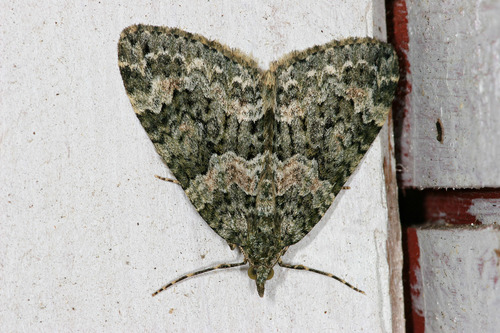
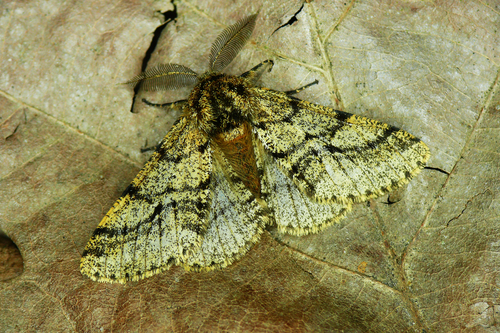
Lycia hirtaria (Clerck, 1759), commonly called the brindled beauty, has a wingspan of 4 to 5 cm. It is a large-bodied, furry moth. Its body and wing pattern gives it near-perfect camouflage against tree trunks, which is how it got its common name. The base color of its forewings is usually grey, covered in fine black speckling. Two curved cross lines, an anterior and an exterior, mark the boundaries of the wing's central area. The hindwings are also grey, and feature two or three cross lines. Females have a pale yellow tint across their wings, and the front edges of their forewings are paler than the rest of the wing. Males have large comb-shaped antennae. There are several described variations of this species. The female variant ab. terroraria Krulik. is solid unicolorous grey, with only faint traces of cross lines along the forewing veins. The female variant ab. fumaria Haw. is fuscous or smoky black, and extreme individuals have no markings at all. The variant diniensis Ob. differs very little from the typical name-type form, but its cross lines are very strong and thick; this variant was illustrated without a written description, and is found in Basses-Alpes. The variant ab. fasciata [Prout], found in Le Canadel, Var, France, is a distinct modified form of diniensis, with a double antemedian line and a blackish band that stretches from the forewing median line to the subterminal area. The variant ab. flavescens [Prout] refers to the more yellow-tinted form of the species that is common in England, Northern France and other nearby regions. The variant ab. congeneraria Hbn. has very clearly double antemedian and postmedian lines, and may form a separate geographic race in Algeria. The variant istriana Galv. is a large, whitish-mixed form from Istria. The race hanoviensis Heymons is smaller, more densely scaled, has a base color mixed with more ochreous-yellow, and has dark markings that extend into strong, broad suffusions. This species can be found across most of Europe, as well as Russia, the Caucasus, Transcaucasia, Asia Minor, South Siberia, Yakutia, the Russian Far East, Sakhalin and Japan. Brindled beauty moths prefer habitats in woodland and suburban areas.