About Lychnorhiza lucerna Haeckel, 1880
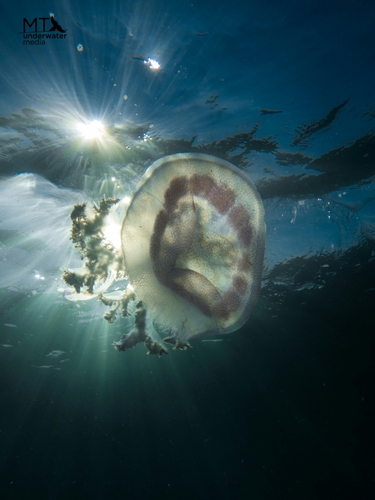
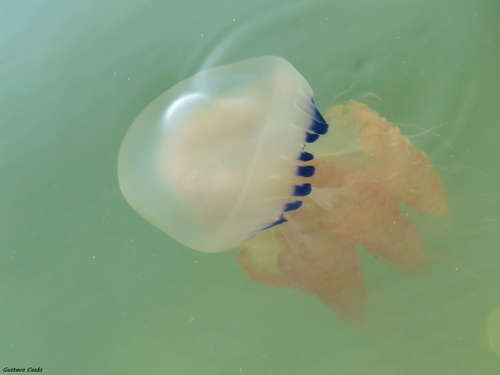
Lychnorhiza lucerna Haeckel, 1880 is a species of jellyfish. When young, this jellyfish has a hemispherical bell that flattens into a saucer shape as it grows. Very large mature specimens can reach 45 centimetres (18 in) in diameter and have a dish-shaped bell. The upper surface of the bell is flexible, thin, and covered in low conical projections. Many small, triangular lappets line the periphery of the bell. Hanging beneath the bell are four pairs of oral tentacles, which reach roughly two thirds of the bell's diameter in length. The upper halves of these oral tentacles are somewhat flattened, while the lower halves split into three vanes with multiple inrolled edges. Suctorial mouthlets leading to the bell's interior, along with various thick dangling filaments, are located among these vanes, and there is no central mouth. The stomach fills most of the bell's interior, and a ring of small cream or white gonads surrounds its edge. The colouration of Lychnorhiza lucerna varies, but generally the bell is translucent and either colourless or a pale buff shade, sometimes with irregular light brown streaks. The dangling lappets around the bell's edge are darker brown, the lower sections of the oral tentacles may also be brown, and the upper sections of the tentacles are colourless. Lychnorhiza lucerna occurs in tropical waters of the western Atlantic Ocean, with a range extending from French Guiana to Buenos Aires Province, Argentina. It inhabits shallow coastal areas and estuaries, where it is the most abundant jellyfish in the order Rhizostomeae, and it often becomes stranded on beaches. This jellyfish forms associations with the parasitic flatworm Dibothriorhynchus dinoi, shrimps of the genus Periclimenes, the Atlantic bumper fish Chloroscombrus chrysurus, and the bluntnose jack Hemicaranx amblyrhynchus. Young spider crabs Libinia ferreirae and Libinia spinosa use the interior of the bell as a nursery, where they are protected from predators.