About Lycaste virginalis (Scheidw.) Linden
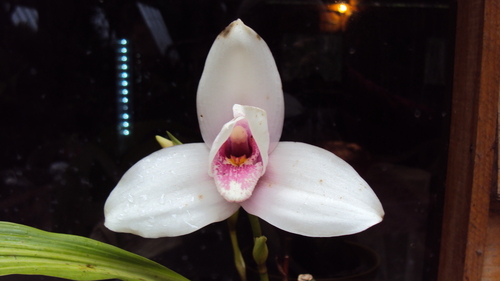
This species, scientifically known as Lycaste virginalis (Scheidw.) Linden, produces long leaves that grow from its thick pseudobulbs. Its flowers are generally borne singly, are triangular in shape, and emerge from the base of the youngest pseudobulb. Flowers measure between 10 and 15 centimeters across, and their color ranges from fully white in the Alba variety, through different shades of pink, to lavender. This clean, pure coloration makes Lycaste virginalis an ideal starting parent for creating Lycaste hybrids. The blooming period occurs between November and April, with peak blooming happening in late January and early February. A mature plant can produce 4 to 12 flowers over a blooming season that lasts between 6 and 8 weeks. It is a hermaphroditic species that can produce millions of seeds inside a capsule-shaped fruit. However, successful germination requires the presence of a specific fungus, which makes the species naturally very rare. Commercial trade of this plant is prohibited in Guatemala. Lycaste virginalis, previously referenced as Lycaste skinneri, grows in humid forests of Mexico, Guatemala, El Salvador, and Honduras. It is most abundant and native to Guatemala. It typically grows at an average altitude of 1,650 meters above sea level, where it is not exposed to damagingly high summer temperatures or damagingly low winter temperatures. Abundant ground-level cloud cover raises relative humidity during the day and through the dry season. The species grows as an epiphyte on the branches of woody trees, at heights that provide suitable lighting conditions. It is very sensitive to temperature changes; temperatures in its preferred habitat range from 27 °C during the day to 18 °C at night. The ideal relative humidity for its development is between 50 and 70 percent.