About Lycaena virgaureae (Linnaeus, 1758)
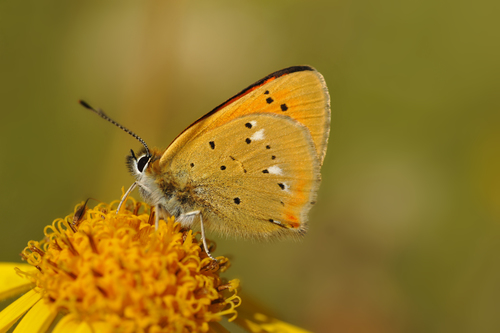
Lycaena virgaureae (Linnaeus, 1758), the scarce copper, has the following wing description from Seitz. Males are red-golden on the upper side, with a narrow black margin; dark dots appear on the hindwing along the proximal edge of this margin. Females are cinnabar-red, spotted with black, and the hindwing is partly dusted with black. The underside is leather-yellow, with sparser black spotting. Pale dots sit before the outer third of the hindwing, and these dots occasionally join to form a white chain. The anal area is dusted with red. This species ranges from Atlantic coasts across Europe to East Siberia, and from the North Sea coast to the Mediterranean, but is not found in Great Britain or Japan. Several different forms and aberrations of the species are recognized. A small form, oranula Frr. (76 b), occurs in Lapland, and is otherwise very similar to the name-typical form. estonica Huene (76 b), found in the Baltic provinces and eastern Russia, matches oranula in size and shape, but has a broader black margin. virgaureola Stgr. (76 b) is the same size as the name-typical L. virgaureae, but the male's upperside matches that of estonica. Underneath, the more reddish disc of the forewing contrasts with the more yellow hindwing, and the white discal stripe of the hindwing is either absent or reduced. This form is found in northern Central Asia, Dauria, and Mongolia, and a similar aberration occurs in the Swiss Alps. Males from the Apennines with deeper red-golden upperside and more densely dark-dusted hindwing base are classified as apennina Calb. Females of this form have paler ground colour and less dark dusting than many Central European specimens, and the underside is lighter. According to Fallou, males from the Pyrenees also have deeper red colouring. On the other hand, specimens from Mersina and the neighbouring Taurus Mountains have bright light golden-red upperside in both sexes, and the male's black margin is narrowed. This form is aureomicans Heyne. Aberration ab. zermattensis Fall. (76 a) groups specimens with strongly grey-dusted hindwing underside, where the female's upperside also takes on a brown-grey tint from dark dusting over the golden ground. These individuals occur alongside the typical form in many alpine districts, and are especially common and well-marked in the Alps of Valais. It is not possible to determine the true characteristics of this aberration from Fallou's very long description, so strictly speaking not all specimens labelled as this form in collections actually belong here, including not all specimens from Valais. Only individuals that have a chain of white dots before the outer third of the hindwing, similar to phlaeas caeruleopunctata and matching the figure published in Ann. Soc. Ent. Fr. vol. V. pl. 2, are true ab. zermattensis. ab. seriata Fruhst. are zermattensis females that have a discal row of white dots on the hindwing proximal to the row of black spots. ab. fredegunda Fruhst. has this row of dots plus an additional row of submarginal spots on the underside of the forewing. More varieties of this species have been described. The egg is semiglobular and grey-green, with a network of polygon shapes, and is laid singly or in groups on the stalk of the host plant. In another account of the life cycle, eggs are white, somewhat larger than eggs of other Lycaena species, laid on dried-out plant parts such as dry sorrel stems, and this is the only Lycaena species whose eggs persist over the winter. The larva is green with a yellow stripe on the back and along the sides, and has a brownish head and brownish legs. It is glassy and transparent when young, and becomes yellow on the back later. It emerges in April and feeds until June on Rumex and Solidago; caterpillars are green, nocturnal, and feed on sorrel. The pupa is rounded and smooth, similar in shape to a small bean. It is brownish with dark markings, and has a dark dorsal longitudinal stripe on the thorax that is continued onto the abdomen by a row of impressed dots. Adult butterflies are on the wing from the end of June into August, found in meadows, forest clearings, mountain-sides and flowery slopes. They are abundant almost everywhere within their range, and can ascend above 10,000 feet in high mountains. Lycaena virgaureae prefers flower-rich meadows that can be either dry or damp in Central Europe. In Spain, it is found in the Pyrenees and the Cantabrian Mountains. In southern France, it occurs in the Massif Central. Its distribution reaches the Arctic Circle in Fennoscandia to the north, and reaches northern and northwestern Greece to the south. In southern Belgium, there are a small number of threatened populations. It is not found on the British Isles or the Netherlands, and its range extends east as far as Mongolia. It is most commonly found at elevations of 1,000 to 2,000 meters, though in Armenia it inhabits meadows up to 2,700 meters above sea level. There were multiple scientific debates about the presence of the scarce copper in Britain during the 19th century. One generation of the butterfly emerges from mid-July to mid-September. Adult butterflies feed on the blossoms of plants including ground-elder, Eupatorium, Valeriana, and burnet saxifrage.