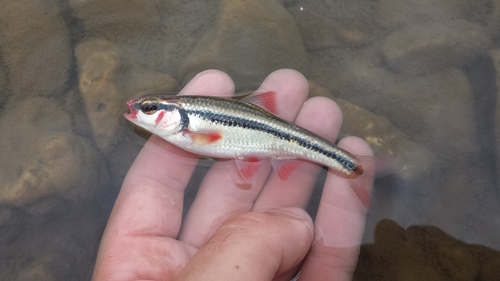
About Luxilus zonatus (Putnam, 1863)
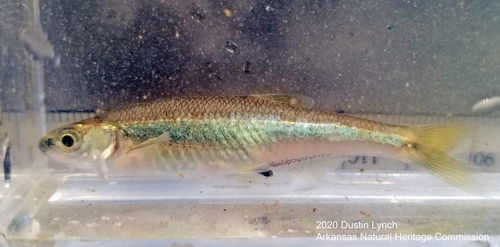
The bleeding shiner, scientifically named Luxilus zonatus (Putnam, 1863), has an olive brown back with a broad dark stripe running along its midline. Its sides are metallic, and marked with two black stripes separated by a golden stripe. One of these black stripes extends to the tip of the snout, while a second, less prominent black stripe runs parallel to the first. A crescent-shaped bar marks the gill opening, and the underside of the fish is silvery white. A key trait that distinguishes the bleeding shiner from similar minnow species is that its side stripe abruptly narrows just after the operculum, then widens again along the body length to reach the caudal fin. While this species shares many similarities with Luxilus pilsbryi, it can be identified by several consistent characteristics: Luxilus zonatus has 9 anal rays, 7 gill rakers, 38 to 43 lateral line scales, and 26 circumferential scales. The origin of its dorsal fin sits closer to the tip of the snout than to the base of the caudal fin. The bleeding shiner has a slightly compressed body, with fins that are relatively large for its body size. Breeding males have bright red markings on their head, body, and fins, with all other markings appearing darker. The species reaches an average total length of about 4 inches (10 cm), with a maximum recorded total length of 4.75 inches (12.1 cm). The bleeding shiner is endemic to Missouri and Arkansas, restricted to the Ozark Plateau of Missouri and northeast Arkansas. It inhabits Ozark-draining tributaries of the Missouri River, as well as the St. Francis, Black, Little, and Meramec Rivers. The species lives in temperate climate regions, and prefers clear, gravel-bottomed streams and rivers. It has very rarely been found in mud-bottomed streams. As a demersal fish, it prefers to live close to the bed of the rivers and streams it inhabits. Young bleeding shiners tend to live in quieter, slower-flowing waters than adult individuals of the species. Spawning for bleeding shiners usually takes place over gravel nests and pits created by other fish, most commonly other minnows. Groups ranging from just a few individuals to one hundred bleeding shiners gather at these sites to spawn. In Missouri, spawning occurs from late April to early July, peaking in late May and June. During the breeding season, males develop breeding tubercles, which are largest on the head, but also appear on the fins and the front of the body. Bleeding shiners are oviparous: females lay eggs that are left unattended after being deposited.