About Lutrogale perspicillata (I.Geoffroy Saint-Hilaire, 1826)
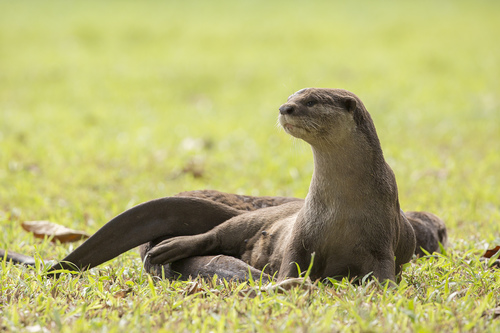
The smooth-coated otter, scientific name Lutrogale perspicillata (I.Geoffroy Saint-Hilaire, 1826), has a short, sleek fur coat that is dark-brown to reddish-brown along the back, and lighter grayish brown on the underside. It can be distinguished from other otter species by its more rounded head, and a vaguely diamond-shaped, hairless nose. Its tail is flattened, unlike the more rounded or cylindrical tails of other otters. It has short, strong legs, with large webbed feet that carry strong, sharp claws ideal for handling slippery fish. This is a relatively large otter species, with a weight range of 7–11 kg (15–24 lb), a head-body length of around 59–64 cm (23–25 in), and a tail that measures 37–43 cm (15–17 in) long. Females have two pairs of teats to nurse small litters of young. This otter is distributed across Pakistan, India, Nepal, Bhutan, Bangladesh, southern China, Myanmar, Thailand, Cambodia, Vietnam, Peninsular Malaysia, Singapore, and the islands of Borneo, Sumatra and Java. There is also an isolated population living in the marshes of Iraq. It is often recorded in saltwater near the coast, especially on smaller islands, but it requires a nearby source of freshwater. It lives in areas with plentiful fresh water, including wetlands, seasonal swamps, rivers, lakes and rice paddies. Where it is the only otter species present, it occupies almost any suitable habitat. But where it shares range with other otter species, it avoids smaller streams and canals, preferring larger water bodies. Groups of smooth-coated otters studied in the Moyar River preferred rocky areas near fast-flowing river segments that had loose sand and little vegetation cover. The population in the Mesopotamian Marshes was once feared to have gone extinct, but otter tracks found in 2009 suggest the population may still survive. Smooth-coated otter skins were found during surveys between 2005 and 2012 near Hammar and Hawizeh Marshes, and tracks and scat found in Erbil Province are also thought to have been left by this species. In Gujarat, smooth-coated otters were documented near lakes, canals and mangroves on the outskirts of Surat in 2015. In Singapore, smooth-coated otters have adapted well to urban environments, and use urban structures such as gaps under buildings as alternative holts. They also use staircases and ladders to move in and out of concrete canals with vertical or near-vertical banks. This Singaporean population is well-protected and steadily increasing, and some families such as the Bishan otter family have become a common sight that attracts media attention. Smooth-coated otters live in groups of up to 11 individuals. They rest on sandy riverbanks, and build their dens under tree roots or among boulders. Observations from Peninsular Malaysia show they are primarily active during the day, with a short rest period at midday. They mark their ranges by urinating and leaving spraint on rocks or vegetation. They communicate through vocalisations including whistles, chirps, and wails. Smooth-coated otters form small family groups made up of a mated pair plus up to four offspring from previous breeding seasons. Copulation occurs in water and lasts less than one minute. When food supplies are sufficient, they breed year-round, but in populations that depend on monsoon precipitation, breeding takes place between October and February. The largest recorded wild-born litter, of seven pups, was observed in Singapore in November 2017. Pups are born after a gestation period of 60 to 63 days, and typical litters have up to five pups. Mothers give birth to and raise their young in a burrow near water; they either build this burrow themselves, or take over an abandoned existing burrow. At birth, pups are blind and helpless, and their eyes open after 10 days. They are weaned at around three to five months, reach adult size at about one year of age, and reach sexual maturity at two or three years.