About Lutreolina crassicaudata (Desmarest, 1804)
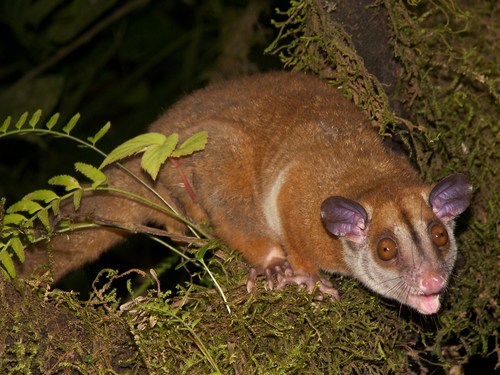
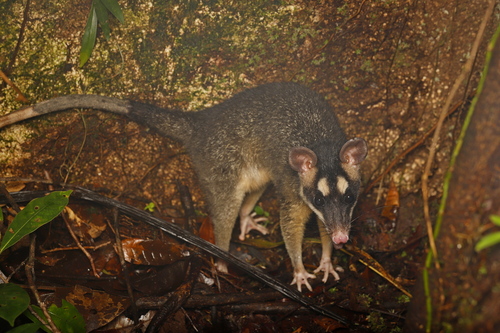
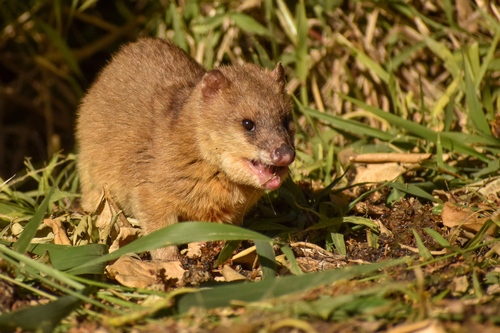
The big lutrine opossum, whose scientific name is Lutreolina crassicaudata (Desmarest, 1804), gets its common name and species epithet from descriptive terms: "lutrine" means otter-like, "crass" means thick or fat, and "cauda" means tail. It is a very distinctive opossum, with a long weasel-shaped body, short legs, small rounded ears, and dense fur that ranges in color from reddish to yellowish. This species is active during the night and twilight (nocturnal and crepuscular), and generally lives in grasslands and savannas located near water. It is primarily terrestrial, but is an excellent swimmer and climber. The big lutrine opossum is distributed across Brazil, Argentina, Bolivia, Uruguay, Paraguay, Colombia, and Guyana. Populations in Colombia and Guyana are isolated from populations of the other listed countries. It occurs in grasslands, savanna grassland, and gallery woodlands with permanent water bodies, within marshy or riparian habitats. The big lutrine opossum constructs tight nests from grass and reeds, or uses abandoned burrows originally dug by armadillos or viscachas. For this species, breeding starts in September and continues through April, after which there is approximately a five-month-long anestrous period, a time when females do not experience estrus. Big lutrine opossums have two breeding periods each year, and produce litters of 7 to 11 offspring. Like most marsupials, offspring are born into the mother's pouch and nurse via lactation until they are developed enough to leave the pouch. Gestation lasts around two weeks, and young are weaned from their mother's milk at approximately three months of age. The first litter of the breeding season is born in September, and the second is born in December or January. Offspring born in a given breeding season reach sexual maturity at six months of age, but do not start breeding until the following year. Males are heavier than females, showing sexual dimorphism that is likely caused by male-male competition for mates.