About Lutraria lutraria (Linnaeus, 1758)
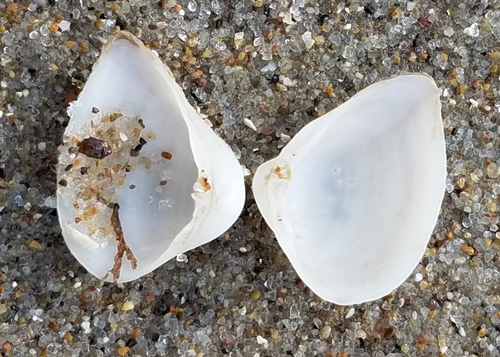
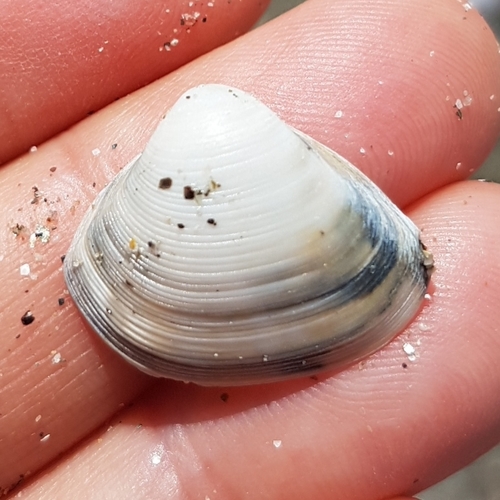
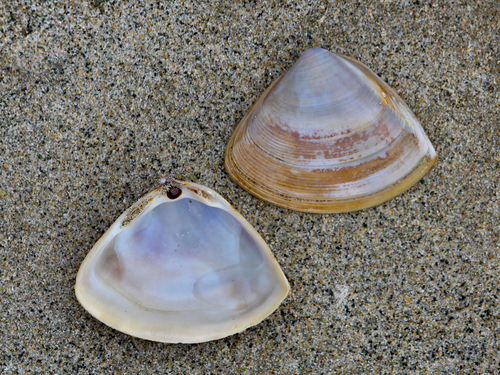
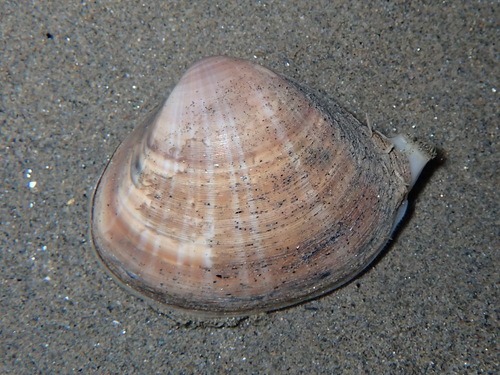
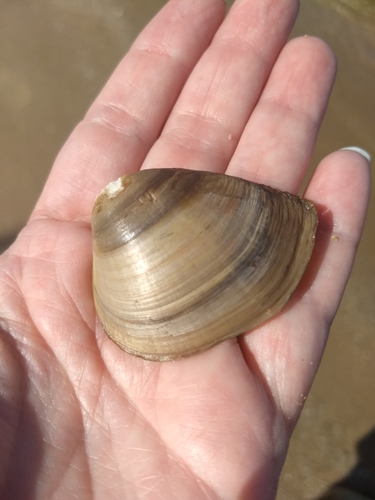
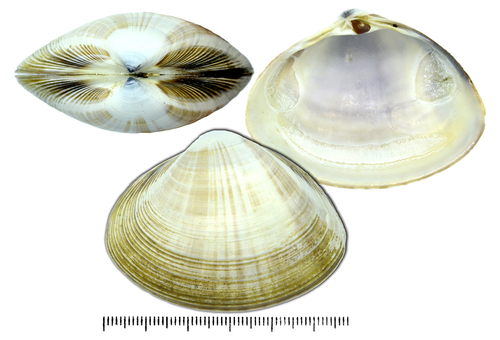
Lutraria lutraria has a pair of large, elongated oval valves that reach up to 15 cm (6 in) in length. The valves are smooth, glossy, and fairly thin, with a creamy base color; their outer periostracum layer is olive brown. This periostracum layer wears away over time, and is often completely missing from shells found on beaches. Concentric sculptured growth lines mark the valves, marking periods of growth, and a few faint radial lines are visible near the hinge. The left valve has two cardinal teeth, with a third small tooth positioned behind them. The right valve has two small cardinal teeth and one small lateral tooth. The soft body of Lutraria lutraria is white. It has a thick foot that protrudes through the pedal gape at the posterior end. The edges of the mantle are fringed with white and are fused together. Its massive, fully joined siphons can extend to two or three times the length of the shell. The siphons are streaked with brown and purple, and are contained within a transparent, gelatinous sheath made of protein and chitin. The siphons are outgrowths of the mantle, while the sheath is a continuation of the periostracum. Two rings of tiny tentacles surround the opening of the inhalant siphon, and one ring of tentacles plus a membrane surround the opening of the exhalant siphon. The mantle has a fourth pallial opening located near the base of the siphon. Lutraria lutraria occurs along the coasts of north-west Europe, ranging from Norway south to the Mediterranean Sea, and is also found in West Africa. It lives in soft substrates, from the low tide mark down to around 100 metres depth. The largest individuals, which have the longest siphons, bury themselves at the greatest depths.