About Lutjanus synagris (Linnaeus, 1758)
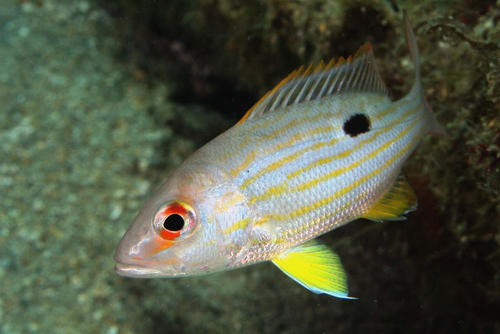
The lane snapper, Lutjanus synagris, has an oblong, compressed body and a sharply pointed snout. It has one pair of front nostrils and one pair of rear nostrils, which are all simple holes. Its mouth is relatively large, with a moderately protrusible upper jaw that sits mostly below the cheek bone when the mouth is closed. Each jaw holds one or more rows of sharp, conical teeth; a small number of these teeth are enlarged to form canines. Vomerine teeth are arranged in an anchor-shaped patch with a short rearward extension along the middle of the palate, and there is a pair of tooth patches on either side of the palate. The preopercle is serrated, with a weakly developed incision and knob. It has a continuous dorsal fin with 10 spines and 12 to 13 soft rays; a slight incision can sometimes be seen between the spines and soft rays. The anal fin has 3 spines and 8 to 9 soft rays. Its pectoral fins are relatively short, do not reach as far as the anus, and contain 15 to 16 fin rays. The caudal fin is emarginate. This fish reaches a maximum total length of 60 cm (24 in), with 25 cm (9.8 in) being a more typical length, and the maximum published weight is 3.5 kg (7.7 lb). This species has two distinct colour phases: a deeper-water phase that is darker and more sharply defined than the shallow-water resting phase. In both phases, the upper flanks and back are pink to red, with a green tint on the back. The lower flanks and abdomen are silver with a yellow hue. There are 3 to 4 yellow stripes on the head that run from the snout to the eye. The flanks are marked with 8 to 10 yellow to pink longitudinal stripes, with an extra 3 to 4 stripes underneath the front dorsal fin ray. The species has an indistinct black spot underneath the soft-rayed part of the dorsal fin, and fins may range from yellow to red in colour. The lane snapper is native to the Western Atlantic Ocean, where it occurs from as far north as North Carolina and Bermuda, south through the Gulf of Mexico and the Caribbean Sea, and along the coast of South America as far south as Santa Catarina, Brazil. It inhabits reefs and sandy bottoms with algae or seagrass, at depths between 30 and 122 m (98 and 400 ft). Juvenile lane snappers live in sheltered inshore waters. Lane snappers form spawning aggregations. Off Cuba, these aggregations occur from March through September, with peak spawning activity in July and August. Off Puerto Rico, spawning peaks in May. This species is a broadcast spawner: fertilised eggs drift with ocean currents and hatch after 23 hours. Little is known about the larvae, but they settle to their habitat when they reach a length of approximately 1 cm (0.39 in).