About Lutjanus sebae (Cuvier, 1816)
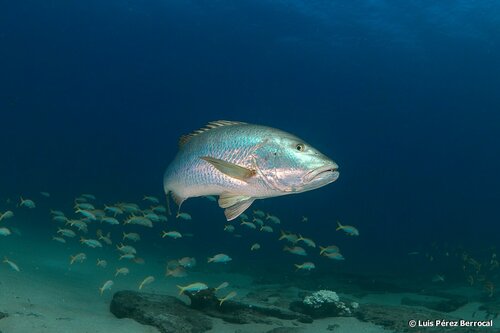
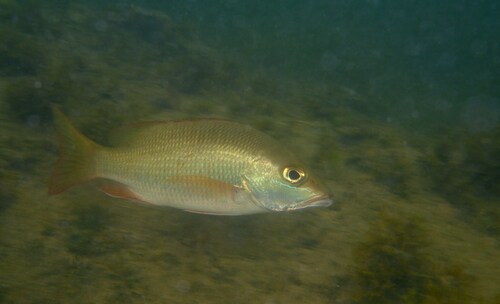
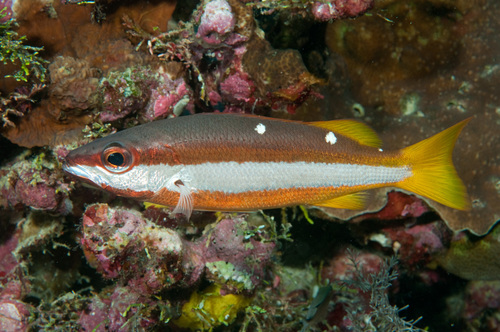
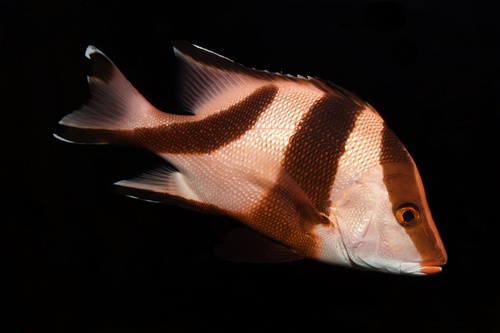
Lutjanus sebae (Cuvier, 1816) has a very deep body, where its standard length is just over twice its body depth. It has a steeply sloped forehead, and the upper profile of its snout is straight or convex. The knob and incision on its preopercle are moderately developed. Vomerine teeth are arranged in a crescent-shaped or triangular patch with no rearward extension, and there are no teeth on its smooth tongue. The dorsal fin has 11 spines and 15 to 16 soft rays, while the anal fin has 3 spines and 10 soft rays; the rear portions of both the dorsal and anal fins are very pointed. The pectoral fins have 17 rays, and the caudal fin is weakly forked. This species reaches a maximum total length of 116 cm (46 in), with 60 cm (24 in) being a more typical size, and the maximum published weight for the species is 32.7 kg (72 lb). Adult fish are overall reddish to pink in body color, with red fins. Juveniles and subadults have three distinct dark bands: a dark red band starting at the tip of the snout, running through the eye, and ending at the anteriormost dorsal fin spine; a wide band running from the middle of the spiny section of the dorsal fin to the pelvic fin; and an oblique band running from the tip of the rearmost dorsal fin spine to the ventral lobe of the caudal fin. Lutjanus sebae has a wide distribution across the Indo-Pacific, ranging from Eastern Africa, from the southern Red Sea to South Africa, east into the Pacific Ocean as far as New Caledonia, south to Australia, and north to southern Japan. In Australian waters, it occurs from Bunbury, Western Australia, around the coast to Sydney. It has been reported twice in recent times from the Mediterranean Sea, near Athens, Greece, and Palermo, Sicily. This species lives on both rocky and coral reefs, and prefers flat areas with either sandy or gravel substrates.