About Lutjanus rivulatus (Cuvier, 1828)
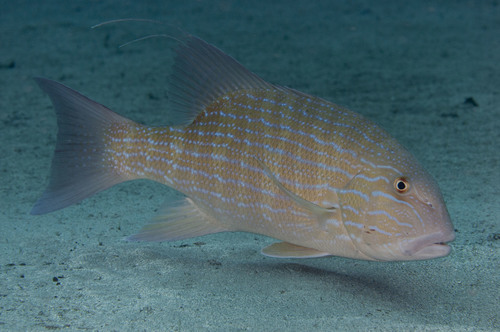
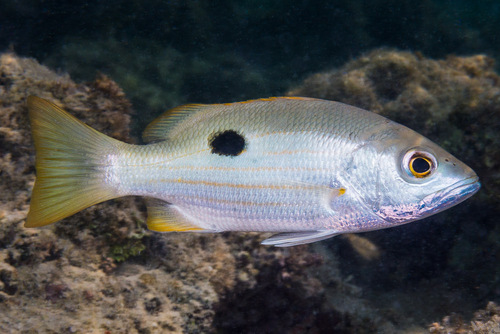
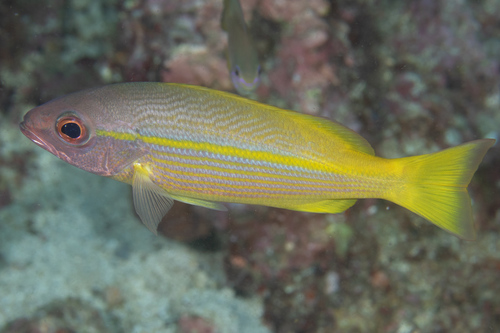
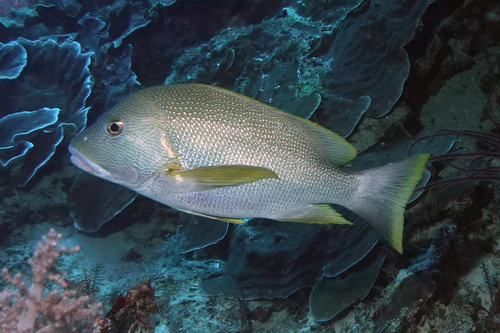
Lutjanus rivulatus has a very deep body, where its standard length is just over twice the maximum body depth. It has a steeply sloped forehead, and the knob and incision on the preopercle are moderately developed. Vomerine teeth form a crescent-shaped patch with no rearward extension, and the smooth tongue has no teeth. The lips are thickened. The dorsal fin has 10 spines and 15-16 soft rays, and has a rounded rear profile. The anal fin has 3 spines and 8 soft rays, and has a sharply pointed rear profile. Pectoral fins contain 17 rays, and the caudal fin is either truncate or weakly emarginate. This species reaches a maximum total length of 80 cm (31 in), with 60 cm (24 in) being a more typical length. The maximum published weight for this species is 11 kg (24 lb). Its overall body color is brown with a reddish hue, and the outer portions of the dorsal, anal, and caudal fins are a contrasting vivid yellow. Blue lines form a pattern on the head, and the body is marked with finer blue dashes and dots. A blurred dark bar runs across the base of the pectoral fin, and this marking becomes even less distinct as the fish matures. In addition to this dark bar, juvenile individuals have a white spot on their flanks, and are also marked with 3 to 8 dark vertical bars. Lutjanus rivulatus has a wide distribution across the Indo-Pacific. It occurs along the eastern African coast from the southern Red Sea to South Africa, extending eastwards into the Pacific Ocean as far as Tahiti and the Austral Islands, northwards to Japan, and southwards to Australia. In Australian waters, it is found from Port Hedland and offshore reefs in Western Australia, Ashmore Reef in the Timor Sea, and extends east and south to northern New South Wales. It also occurs in the Coral Sea and at Christmas Island. It inhabits depths between 1.5 m and 100 m (4 ft 11 in and 328 ft 1 in) and is associated with reefs. Adult individuals are found on deep coastal slopes, while juveniles live on flats with algal growth, frequently near freshwater discharge sites.