About Lutjanus novemfasciatus Gill, 1862
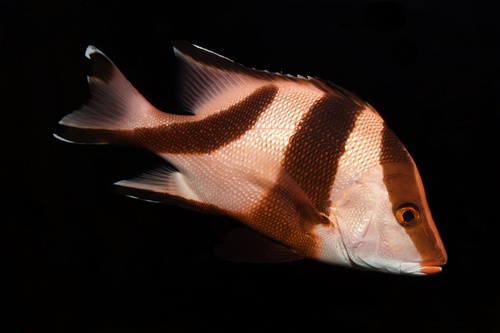
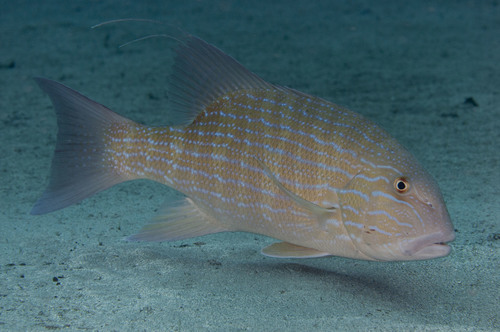
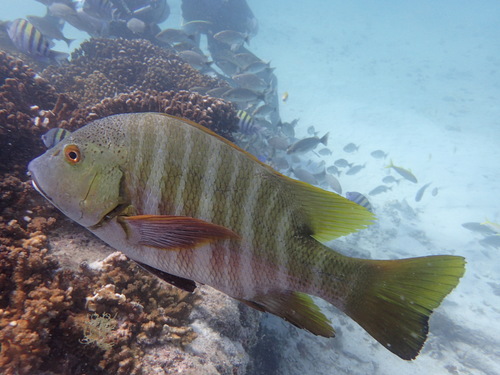
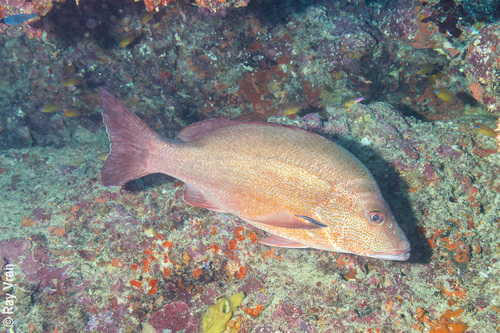
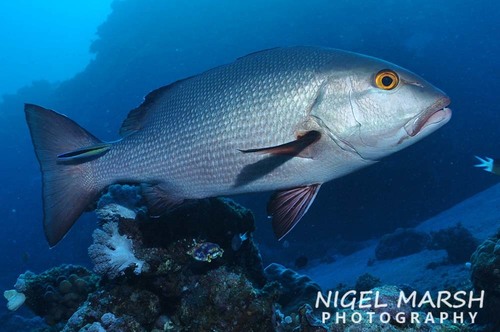
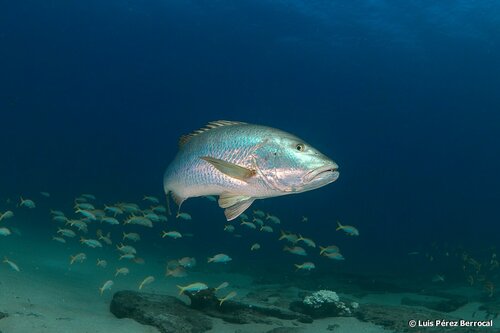
Lutjanus novemfasciatus has an oblong body, with a depth equal to 31% to 35% of its standard length. It has a sharp snout that holds two pairs of nostrils, which are simple holes: one pair at the front, and a second pair behind the first. It has a large, protrusible mouth with conical and canine-like teeth on the jaws, and the front teeth are enlarged into "fangs". Its serrated preoperculum has an incision and a knob, but these features are only moderately or weakly developed. Vomerine teeth are arranged in a crescent-shaped patch with no rearward extension, and the tongue holds several patches of granular teeth. The fangs at the front of the mouth are longer than the diameter of the pupil. The dorsal fin has 10 spines and 13 to 14 soft rays, while the anal fin has 3 spines and 8 soft rays. The dorsal fin is continuous, and both the dorsal fin and anal fin have rounded rear ends. The pectoral fins have 16 or 17 rays, and the caudal fin may be either truncate or weakly emarginate. This is the largest species of snapper, reaching a maximum total length of 170 cm (67 in) and a maximum published weight of 35.7 kg (79 lb). Its overall body color ranges from dark to pale red, and shades to silver on the abdomen. Juveniles and most adults have 8 to 9 vertical bars marked on the upper flanks. Even in adults that show these bars, the markings may fade quickly after death. The fins are mostly brownish in adults; in juveniles, the caudal fin is black, as is the margin of the spiny portion of the dorsal fin. The skin on the inside of the mouth is orange. Lutjanus novemfasciatus is native to the eastern Pacific Ocean, where it occurs from southern California to Peru. This range includes the Gulf of California, Galápagos Islands, Cocos Island and Malpelo Island. It is an inshore, reef-associated fish that prefers hard substrates, though juvenile individuals have been recorded entering freshwater.