About Lutjanus kasmira (Forsskål, 1775)
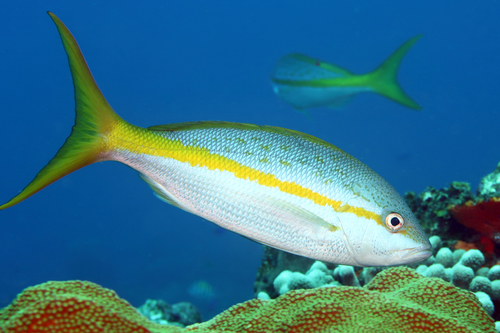
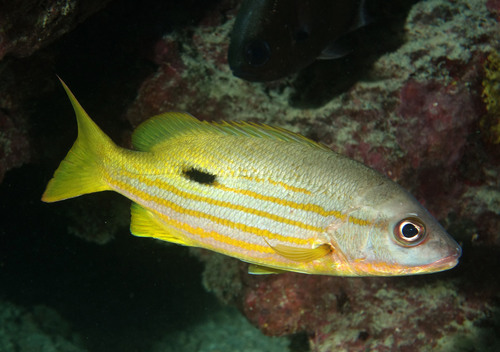
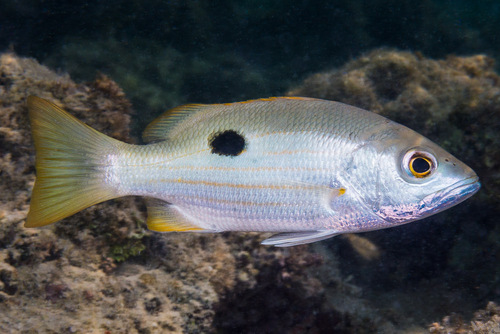
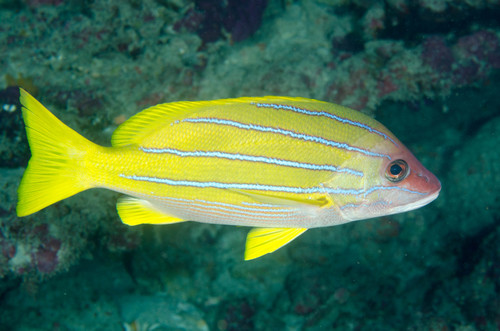
Lutjanus kasmira (Forsskål, 1775), commonly called bluestripe snapper, has a moderately deep body profile, with a steeply sloped dorsal head profile, and a well-developed preopercular notch and knob. Key identifying morphological traits are the counts of its gill rakers: the lower limb of the first gill arch holds 13 or 14 rakers, while the total number of rakers on the first arch ranges from 20 to 22. The dorsal fin has 10 spines followed by 14 or 15 soft rays, and the anal fin has 3 spines and 7 or 8 soft rays. Pectoral fins have 15 or 16 rays, and the caudal fin is slightly emarginate. Scales on the back run obliquely upward above the lateral line, and the lateral line itself contains between 48 and 51 scales. This species can grow up to 40 cm (16 inches) in total length, though most individuals do not exceed 25 cm (9.8 inches). Color is the most diagnostic feature of this fish, particularly when the individual is alive or fresh from the water. The back and sides are bright yellow, fading to white on the lower sides and underside of the head. Four bright-blue longitudinal stripes run along the side of the fish, with several faint greyish stripes on the lowermost part of the sides. Most of the fins are yellow. Bluestripe snapper is one of the most widespread species in the Lutjanidae family. Its range extends from the Red Sea coast of Egypt, south to Madagascar, and east to India, China, Southeast Asia, Australia, and many Pacific islands. Like most snappers, it lives on coral reefs, and occurs in both shallow lagoons and outer reef slopes down to at least 60 m (200 ft). Recorded maximum depths are 180 m (590 ft) at the Marquesas Islands and 265 m (869 ft) in the Red Sea. In Hawaii, bluestripe snappers also spend time over seagrass beds and sandy substrates. During daylight hours, they frequently gather in large groups around coral formations, caves, or wrecks. Preferred habitat changes with age: young fish school over sandy substrates, while larger fish are more solitary and live on deep reefs. Bluestripe snapper reaches sexual maturity when it grows to between 20 and 25 cm (7.9 to 9.8 inches) in length. In lower latitudes, spawning happens through most of the year; in the Andaman Sea, peak spawning activity occurs in November and December. The species' eggs measure between 0.78 and 0.85 mm (0.031 to 0.033 inches) in diameter, and hatch when water temperatures reach 22 to 25 °C (72 to 77 °F).