About Lutjanus johnii (Bloch, 1792)
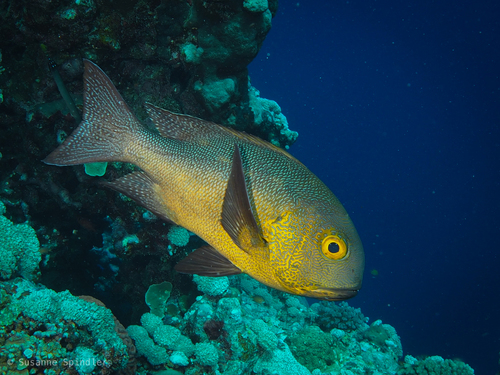
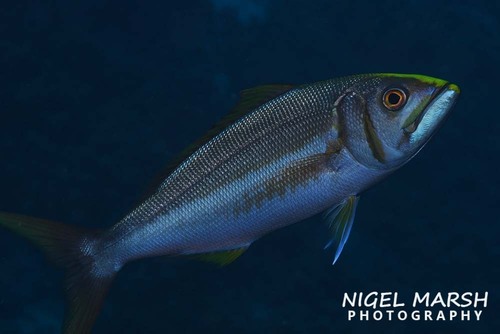
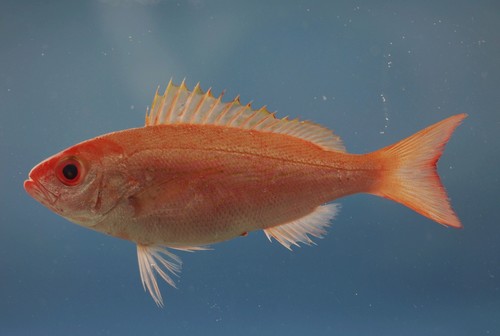
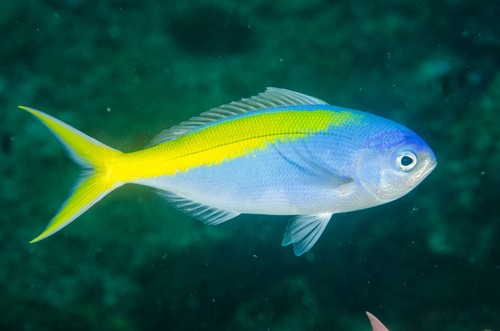
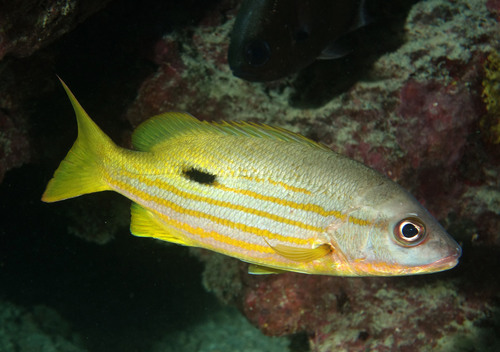
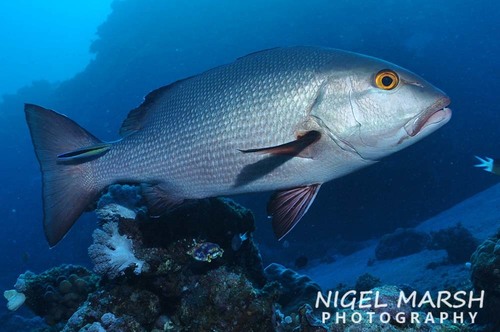
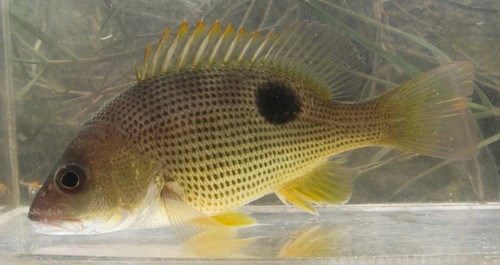
Lutjanus johnii (Bloch, 1792) has a moderately deep body, with its standard length measuring 2.4 to 2.9 times the body depth at its deepest point. It has a steeply sloped forehead, and the incision and knob on the preoperculum are weakly developed. Vomerine teeth are arranged in a crescent-shaped patch with no rearwards extension, but there is a patch of granular teeth on the tongue. The dorsal fin has 10 spines and 13 to 14 soft rays, while the anal fin has 3 spines and 8 soft rays. The soft portions of both the dorsal fin and anal fin are rounded in shape. The pectoral fins have 16 or 17 rays, and the caudal fin is truncate or weakly emarginate. This species reaches a maximum total length of 97 cm (38 in), with 50 cm (20 in) being a more typical adult size, and the maximum published weight for the species is 10.5 kg (23 lb). Its overall body colour is yellow, with a bronze or silvery sheen, and the abdomen is silvery-white. Each scale has a rusty spot at its centre, which creates the appearance of horizontal lines running along the fish's flanks. A sizeable black blotch sits below the front of the soft-rayed section of the dorsal fin, and this blotch is mostly located above the lateral line; this marking may be absent in adult individuals. Lutjanus johnii has a wide distribution across the Indo-Pacific region. Its range extends along the eastern African coast from the southern Red Sea to South Africa, across the Indian Ocean, and into the Pacific Ocean as far east as Fiji. It can be found as far north as the Ryukyu Islands of southern Japan, and as far south as northern Australia. It occurs at depths between 0.1 m and 80 m. Adults are thought to live on coral reefs, while juveniles shelter in mangroves.