About Lutjanus jocu (Bloch & Schneider, 1801)
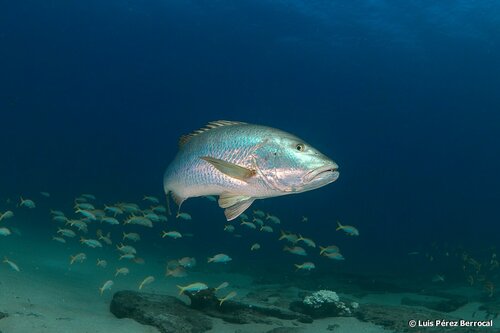
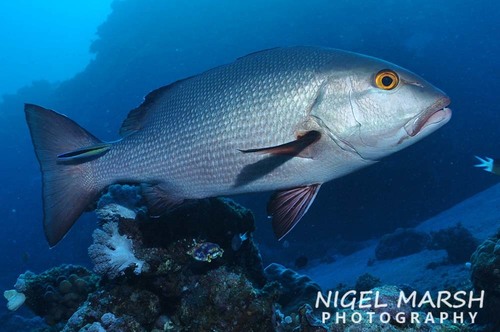
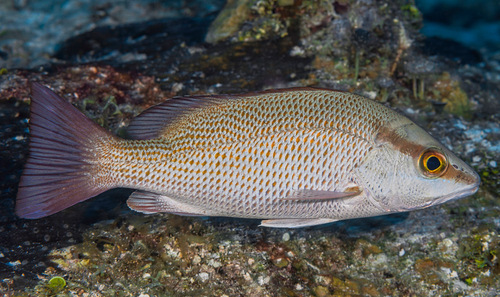
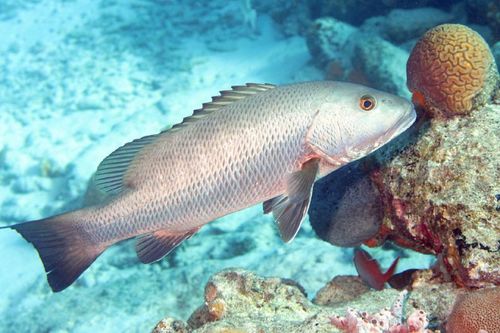
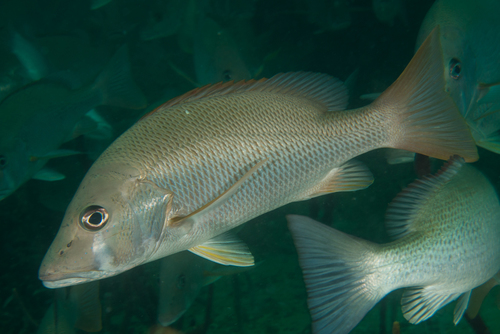
Lutjanus jocu, commonly called the dog snapper, has a relatively deep, compressed body. It has long pectoral fins, an emarginate or slightly forked caudal fin, a rounded anal fin, and a bilobed dorsal fin. Its nostrils are arranged in front and rear pairs, and are simple tubes. It has a relatively large mouth with a moderately protrusible upper jaw that slips under the cheekbone when the mouth is closed. A pair of very enlarged canine-like teeth in the upper jaw remain visible even when the mouth is closed. Vomerine teeth are arranged in a chevron or crescent shape, with a long rearward extension running from the middle of this shape that creates an anchor-like outline. There is also a patch of teeth on each side of the roof of the mouth. The preoperculum has a weakly developed incision and knob. The dorsal fin has 10 spines and 14–15 soft rays, while the anal fin contains 3 spines and 8 soft rays. The long pectoral fin extends as far as the anus and contains 16-17 rays. This fish reaches a maximum total length of 128 cm (50 in), with 60 cm (24 in) being a more common typical length, and the maximum published weight for the species is 28.6 kg (63 lb). Adult dog snappers have olive green upper flanks and backs, which may be marked with slender light-coloured bars. Their lower flanks and abdomen are pale red and copper, and there is a white triangular bar beneath the eyes. The pectoral, pelvic, and anal fins, as well as the outer parts of the soft-rayed section of the dorsal fin and the caudal fin, are reddish, while the remaining sections of the dorsal and caudal fins are olive green. Juveniles have a longitudinal blue line under the eye that extends onto the gill cover; this line breaks up into a row of spots in adult fish. The dog snapper is mainly found in the western Atlantic Ocean, where its range extends from Massachusetts south to São Paulo, Brazil, and includes Bermuda, the Caribbean Sea, and the Gulf of Mexico. It is also found in the eastern Atlantic from Saint Paul's Rocks south to Príncipe. A single first record of the species was reported from the Mediterranean Sea in 2005, in Ligurian waters off Italy. Adult dog snappers are generally found around rocky outcrops or coral reefs, while juveniles primarily stay within estuaries and occasionally enter rivers. This species has been recorded at depths exceeding 100 m (330 ft) in some areas, but it is most frequently found between 5 and 30 m (16 to 98 ft) deep.