About Lutjanus goreensis (Valenciennes, 1830)
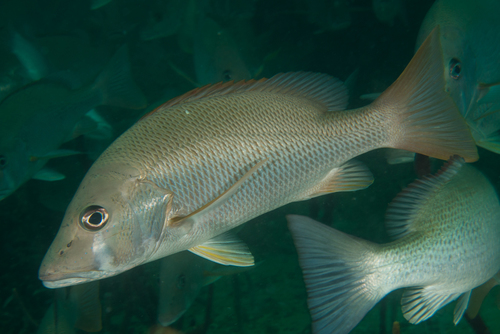
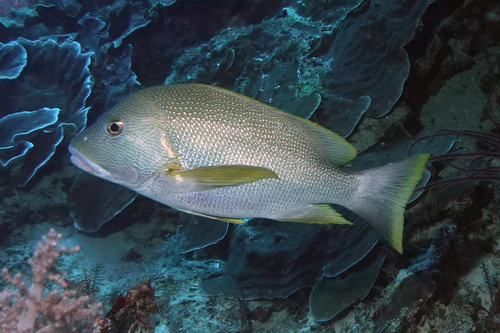
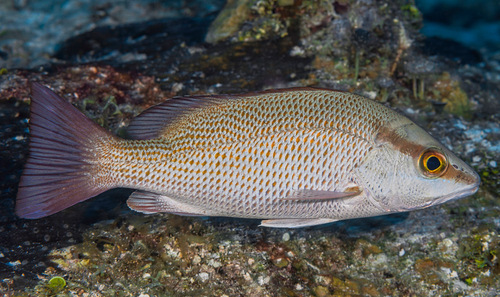
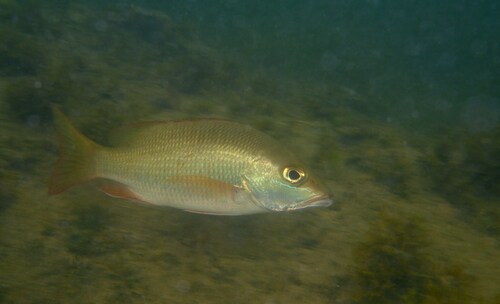
The Gorean snapper (Lutjanus goreensis) has a relatively deep body, with a pointed snout and a steeply sloping forehead. Its vomerine teeth form a triangular patch with a distinct rearwards extension. The dorsal fin has 10 spines and 14 soft rays, while the anal fin has 3 spines and 8 soft rays. Pectoral fins have 16 rays, are relatively short, and do not reach as far as the anus, and the caudal fin is slightly emarginate. This species reaches a maximum total length of 80 cm (31 in), with 50 cm (20 in) being the more common typical length. The back and upper flanks are vivid pink or reddish, and the lower flanks and abdomen are silvery-white. A thin blue band or a line of broken spots runs underneath the eye. Smaller individuals living in shallow water are mostly brownish in colour. The Gorean snapper is native to the eastern Atlantic Ocean. Its range stretches along the western coast of Africa from Senegal in the north to Angola in the south, and it is less common in areas south of the Congo River. It has also been recorded in the Cape Verde Islands, the Canary Islands, and Madeira. Adult Gorean snappers live over rocky substrates and near coral reefs. Juveniles are most often found in coastal waters, particularly in estuaries, and are occasionally seen in the lower reaches of rivers. This species occurs at depths ranging from 0 to 50 m (0 to 164 ft).