About Lutjanus gibbus (Forsskål, 1775)
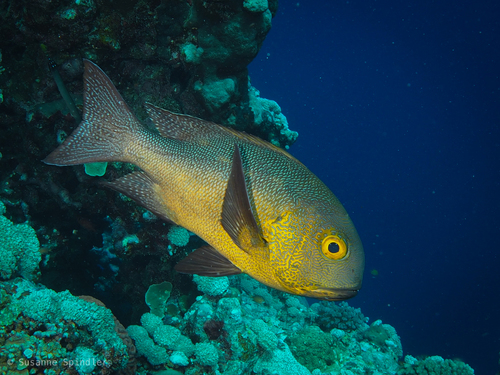
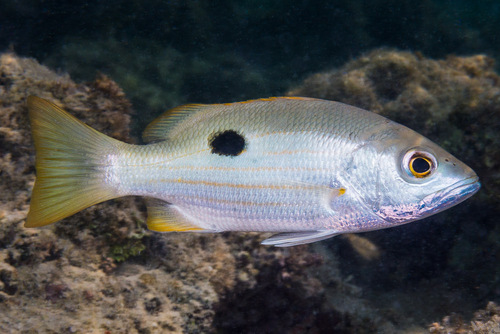
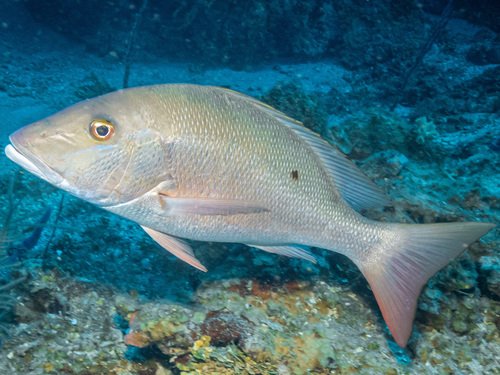
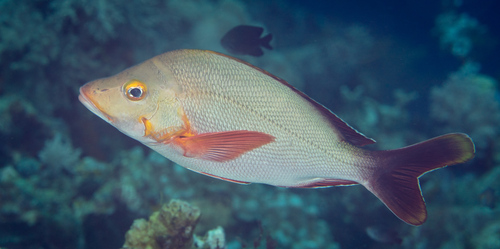
The humpback red snapper, Lutjanus gibbus, has a body where standard length is 2.2 to 2.5 times its depth. It has a head with a very steeply sloped forehead, and a well-developed notch on the preoperculum. Vomerine teeth form a crescent-shaped patch with no rearwards extension, and the smooth tongue has no teeth. The dorsal fin has 10 spines and 13–14 soft rays, while the anal fin has 3 spines and 8 soft rays. The rear sections of both the dorsal and anal fins are pointed. The pectoral fins have 16 to 17 rays, and the caudal fin is forked with rounded lobes. This species reaches a maximum total length of 50 cm (20 in), though 45 cm (18 in) is more typical. Its overall body color is red or grey, darker on the back and upper head. There is an orange tint on the lower part of the gill cover and in the axil of the pectoral fin. Fins are often red, but median fins are normally dark brown to blackish, with a thin white margin along the soft-rayed part of the dorsal fin, the anal fin, and the caudal fin. Juveniles have a large circular black spot at the base of the caudal fin. Lutjanus gibbus has a wide distribution across the Indo-West Pacific. Its range extends from the eastern African coast and the Red Sea to the Society and Line islands, and from Australia in the south to southern Japan in the north. It has also been recorded from the Marquesas, and as far south as Rapa Iti. In Australia, it is found from Houtman Abrolhos to the Dampier Archipelago and reefs off the northern coast of Western Australia, as well as at Ashmore Reef in the Timor Sea. On Australia's eastern coast, it occurs from the outer Great Barrier Reef and Coral Sea reefs south to Moreton Bay in Queensland, with juveniles found as far south as Sydney. The humpback red snapper lives at depths between 1 and 150 m, and is associated with reef habitats. During the day, it gathers in large, mostly stationary aggregations on coral reefs, and these aggregations are dominated by subadults. Juveniles take shelter in seagrass beds in protected areas with sandy and muddy substrates. Larger adult individuals inhabit deeper waters on coastal slopes.