About Lutjanus fulvus (Forster, 1801)
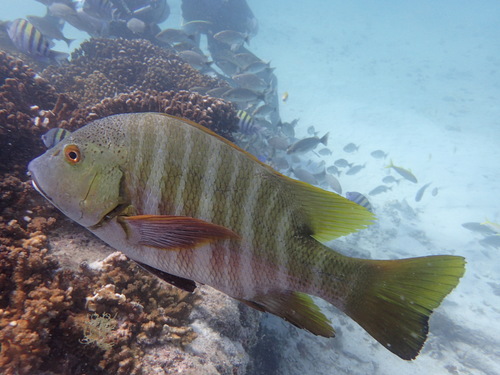
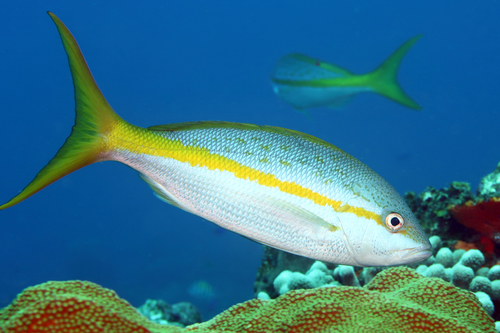
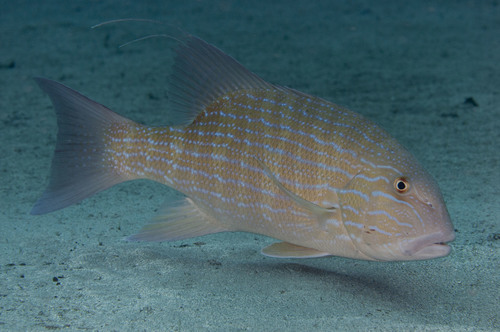
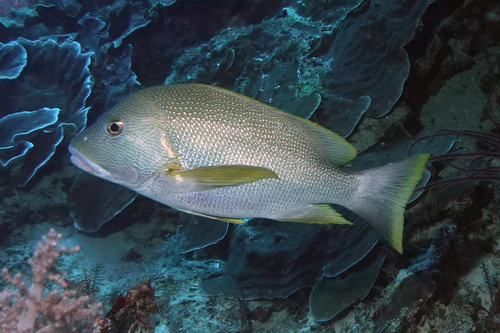
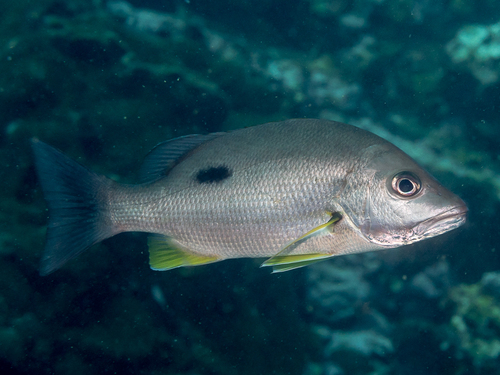
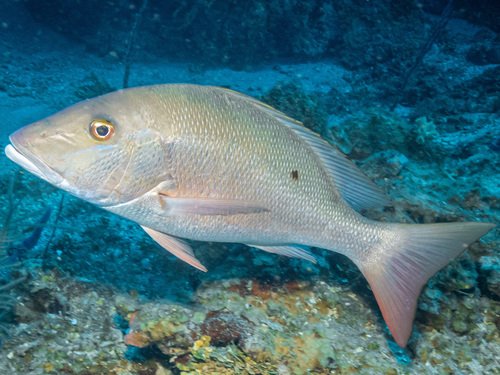
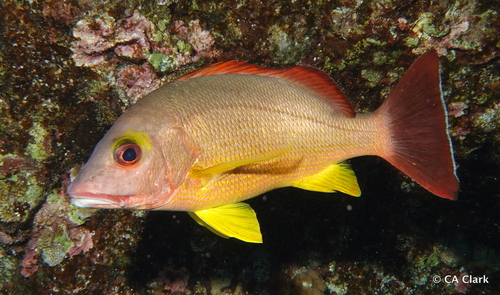
Lutjanus fulvus has a standard body length approximately four times its body depth. It has a steeply sloped forehead, a well-developed notch on the preoperculum, and vomerine teeth arranged in a crescent-shaped patch with no rearward extension. Its tongue is smooth and lacks teeth. The dorsal fin has 10 spines and 14 soft rays, while the anal fin has 3 spines and 8 soft rays; the rear profile of both fins is rounded. The pectoral fins contain 16 rays, and the caudal fin is slightly emarginate. This species reaches a maximum total length of 40 cm (16 in), with 25 cm (9.8 in) being the more typical size. Its overall body color ranges from orange-brown or brownish to pale yellowish or whitish. The dark reddish to blackish dorsal and caudal fins have a white margin, while the anal, pectoral, and pelvic fins are yellow. Its scales have brownish to yellow margins, and there is a yellow patch over the eye. Juveniles have yellowish horizontal stripes and a black band just below the margin of the dorsal fin.
Lutjanus fulvus has a wide Indo-Pacific distribution. It occurs from the Gulf of Aden and East Africa south to South Africa, across the Indian Ocean, but is absent from the Persian Gulf, and extends east as far as the Marquesas and Line Islands. It is found north to southern Japan and south to Australia. In Australia, it occurs from Scott Reef (Western Australia) and Ashmore Reef in the Timor Sea to Sydney, and is also present at Christmas Island, the Cocos (Keeling) Islands, and Norfolk Island in the Tasman Sea. In the 1950s, the Hawaiian Division of Fish and Game released blacktail snappers into Pearl Harbor and off Oahu, and the species is now found throughout the Hawaiian archipelago, though it is never abundant anywhere in the region. It has a depth range of 2 to 75 m (6 ft 7 in to 246 ft 1 in), and inhabits lagoons and semi-sheltered seaward reefs. This species was one of the first to re-colonize a recently dredged reef area off Pohnpei. It prefers sheltered areas with deep holes or large boulders. Juveniles are occasionally recorded in shallow mangrove swamps and the lower reaches of freshwater streams.