About Lutjanus fulviflamma (Forsskål, 1775)
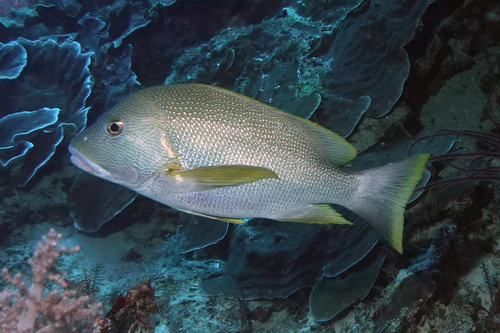
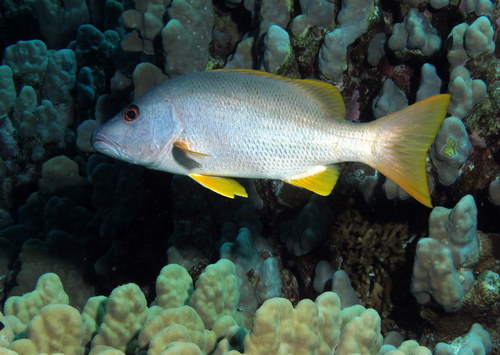
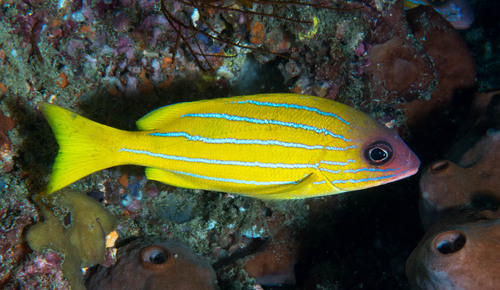
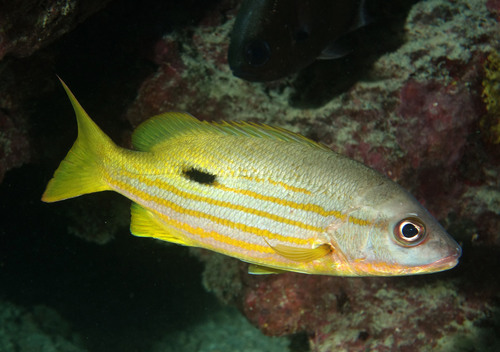
Lutjanus fulviflamma, the dory snapper, has a body that ranges in shape from moderately deep to relatively slender; its standard length is 2.5 to 2.9 times its body depth, and the slope of its head is not very steep. The incision and knob on its preoperculum are not well developed. Vomerine teeth may be arranged in either a triangular patch with a posterior extension or a rhombus shape, and a patch of grain-like teeth is present on the tongue. The dorsal fin has 10 spines and 12 to 14 soft rays, while the anal fin has 3 spines and 8 soft rays. The rear portions of the dorsal and anal fins range in shape from rounded to quite angular. The pectoral fins hold 15 to 17 rays, and the caudal fin may be either truncate or slightly emarginate. This species reaches a maximum total length of 35 centimetres (14 inches), though 30 centimetres (12 inches) is a more typical total length. This snapper has a pale-coloured body marked with 5 to 7 narrow yellow horizontal stripes of equal width along its flanks; the longest of these stripes runs through the eye and onto the snout. A quadrilateral black spot sits on the lateral line, three-quarters of the way between the head and the caudal fin. Lutjanus fulviflamma has a wide distribution across the Indo-Pacific. It is found in the Red Sea from the Gulf of Suez and Gulf of Aqaba, south along the eastern African coast to eastern South Africa, and eastward through the Indian Ocean (including the Persian Gulf) into the Pacific Ocean as far east as Samoa. Its range extends north to the Ryukyu Islands of southern Japan and south to northern Australia. There is also a single recorded observation of this species in the Mediterranean Sea, off Malta; phylogenetic analysis confirms this individual had an eastern African origin. It occurs at depths between 0.5 and 35 metres (1 foot 8 inches and 114 feet 10 inches) across a variety of different habitats. Juveniles occasionally live in brackish lagoons and estuaries, while adults normally form schools over coral reefs and in deeper lagoons.