About Lutjanus ehrenbergii (Peters, 1869)
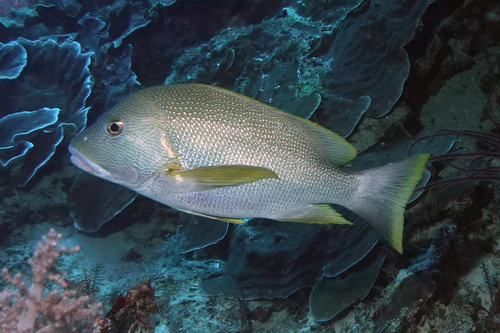
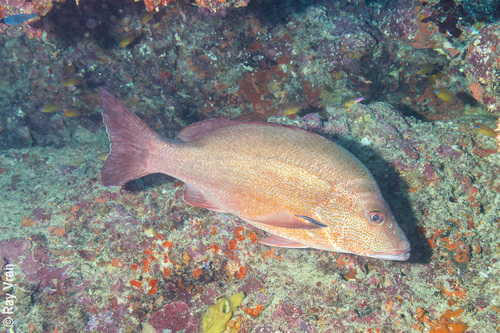
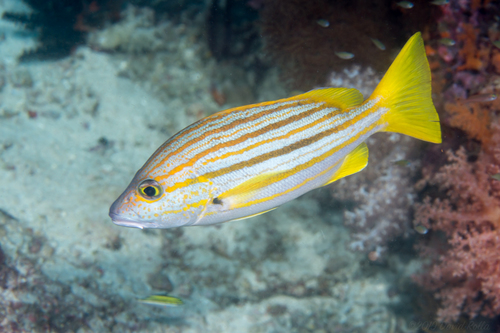
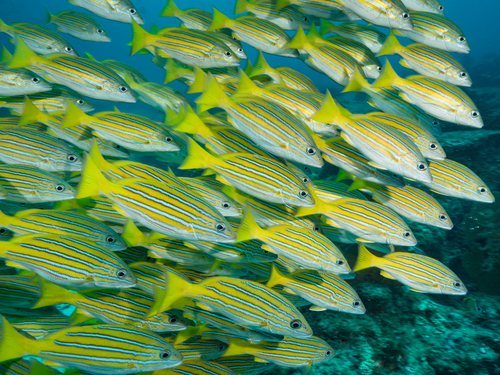
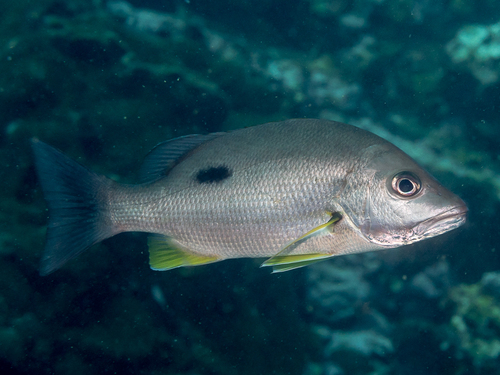
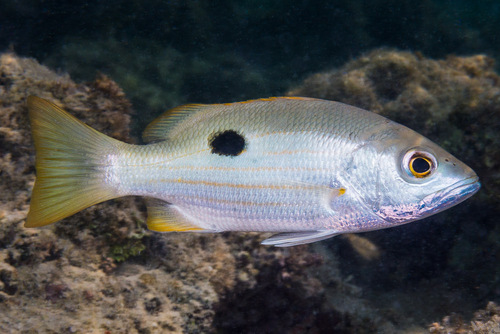
Lutjanus snappers range from small to large in size, with oblong bodies that can be deep, slender, or fusiform in shape. They have relatively large, protractable mouths. Their teeth are arranged in one or more rows along the jaws, and are pointed and conical; the outer row is made up of canine-like teeth, with the frontmost teeth enlarged into more prominent canine fangs. Vomerine teeth form patches that may be chevron-shaped, triangular, lunate, or rhombus-shaped, and patches may or may not have a posterior extension. The space between the eyes is convex, and these snappers have a serrated preopercle with a deep incision on its lower margin. A bony knob sometimes forms between the operculum and the preopercle, which is most visible in species that have a deep preopercle incision. They have a continuous dorsal fin, which often has a slight incision between its spiny portion and soft-rayed portion. The spiny section of the dorsal fin holds 10 or 11 spines, while the soft-rayed section holds 11 to 16 rays. The anal fin has 3 spines and 7 to 10 soft rays, and the pectoral fins have 15 to 18 soft rays. Both the dorsal and anal fins are scaled, while the caudal fin may be emarginate, truncate, or, rarely, forked. These snappers vary widely in color, and frequently have a base background color of reddish, yellow, grey, or brown, covered by a pattern of darker stripes or bars. They are often marked with a large blackish spot on the upper flanks, below the front soft rays of the dorsal fin. Lutjanus snappers have a circumtropical and subtropical distribution, and are found in the Atlantic, Indian, and Pacific Oceans. Two species, the mangrove red snapper Lutjanus argentimaculatus and the dory snapper Lutjanus fulviflamma, have been recorded in the Mediterranean, and are thought to be Lessepsian migrants that entered the sea through the Suez Canal from the Red Sea. The dog snapper Lutjanus jocu, a species native to the western Atlantic, has been recorded in the Ligurian Sea. Many species are associated with coral reefs, where they are prominent members of the reef fish fauna. Some larger red snapper species move into deeper waters, reaching depths of at least 200 m (660 ft). Two species, L. fuscescens and L. maxweberi, are found exclusively in fresh and brackish waters.