About Lutjanus decussatus (Cuvier, 1828)
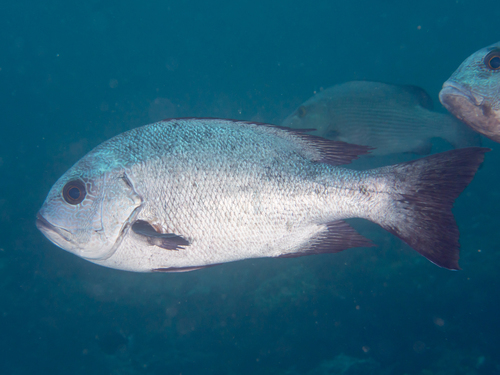
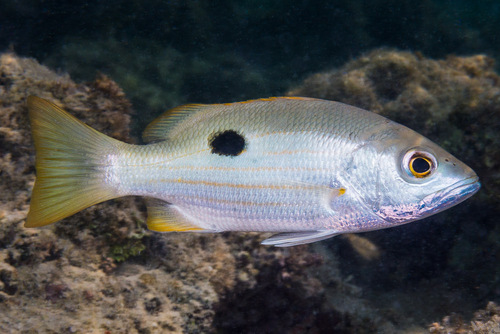
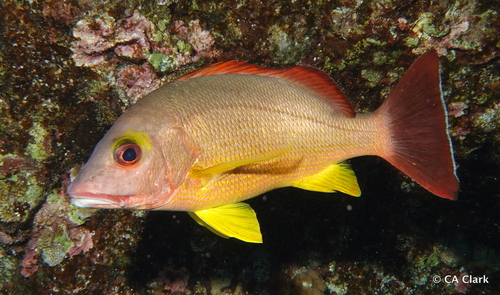
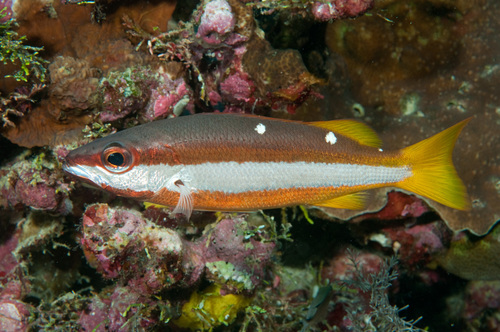
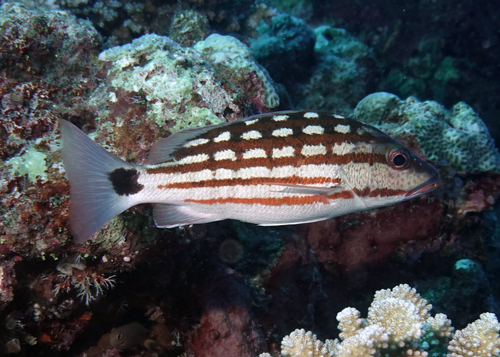
Lutjanus decussatus has a moderately deep body, where body depth ranges between one quarter and one third of the species' standard length. The upper profile of its head has a moderate slope. The preoperculum has a weak knob and notch. Vomerine teeth are arranged in a crescent-shaped patch with no rearward extension, and a patch of grain-like teeth is present on the tongue. The dorsal fin has 10 spines and 13 to 14 soft rays, while the anal fin has 3 spines and 8 to 9 soft rays. The rearmost portions of both the dorsal and anal fins are rounded in shape. The maximum recorded total length for this species is 35 centimeters (14 inches), though a length of 25 centimeters (9.8 inches) is more typical. The overall color pattern of L. decussatus forms a checkered pattern on the upper flanks from whitish to pale grayish brown to reddish brown stripes and bars. Individuals have a large black spot on the base of the caudal fin, pale colored fins, and a red submarginal stripe on the caudal fin. Lutjanus decussatus occurs in the Indo-West Pacific region. Its range extends east from Sri Lanka and eastern India to Micronesia, north to the Ryukyu Islands of southern Japan, and south to Australia. In Australia, the species is found at the Dampier Archipelago and offshore reefs of northern Western Australia, at Ashmore Reef in the Timor Sea, and on the northern Great Barrier Reef off Queensland. It inhabits relatively shallow water, at depths between 2 and 30 meters (6 feet 7 inches to 98 feet 5 inches), found on coastal reef faces and sandy slopes with scattered patches of reef. It occurs less commonly on offshore reefs. Juveniles are found on sheltered reef flats.