About Lutjanus cyanopterus (Cuvier, 1828)
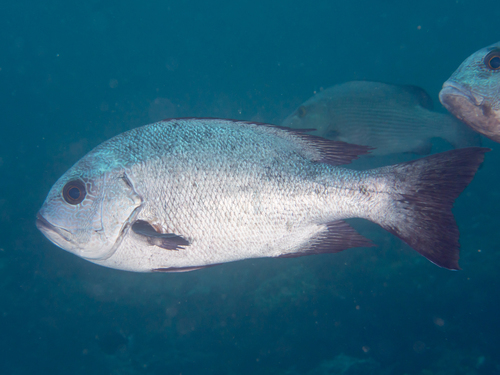
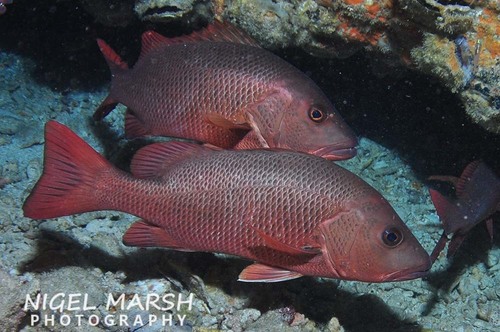
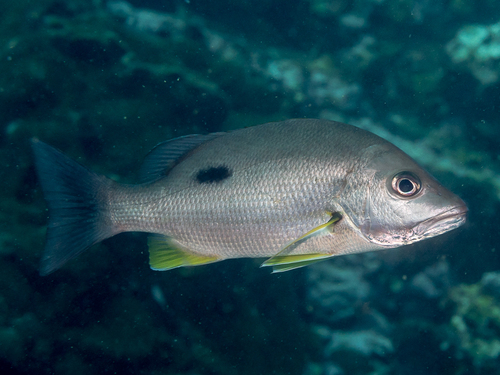
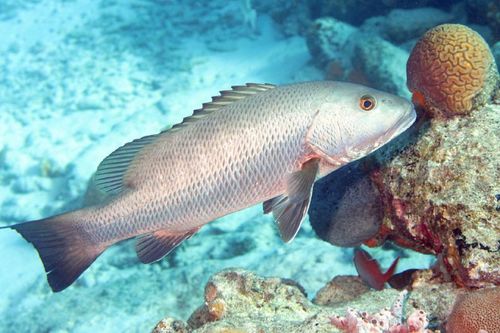
The cubera snapper, scientifically named Lutjanus cyanopterus (Cuvier, 1828), has an oval, streamlined, elongate body that is less deep than the bodies of many other snapper species. Its snout holds two pairs of simple nostrils: one pair at the front, and one pair at the rear. The mouth is relatively large with thick lips, and the jaws bear canine teeth; one enlarged pair of these canines remains visible even when the mouth is closed. Vomerine teeth form a crescent-shaped or triangular patch with no central extension toward the back, and there is an additional tooth patch on each side of the mouth’s roof. The preoperculum has a weakly developed knob and notch. This species has long pectoral fins, a continuous dorsal fin, and a truncated caudal fin. The dorsal fin has 10 spines and 14 soft rays, while the anal fin has 3 spines and 7 to 8 soft rays; a notch behind the spiny section of the dorsal fin is sometimes observed. The maximum recorded total length of the cubera snapper is 160 cm (63 in), though 90 cm (35 in) is a more typical length, and the maximum published weight is 57 kg (126 lb). Its overall body color ranges from grey to dark brown, with pale to dark-grey flanks; some individuals have a faint reddish hue across the body. The caudal fin is light grey, pectoral fins may be translucent to pale grey, and a bluish tint appears on the anal, pectoral, and pelvic fins. Juvenile cubera snappers have an indistinct barred pattern on their flanks. The cubera snapper is distributed in the western Atlantic Ocean, ranging from Nova Scotia in the north to Santa Catarina, Brazil in the south. It is also found throughout the Caribbean Sea and the Gulf of Mexico, around Bermuda, and has been recorded in the Flores Islands of the Azores. This species occurs at depths from 1 to 85 m (3 ft 3 in to 278 ft 10 in). Juveniles seek shelter in seagrass beds in inshore waters or within mangroves, and have been recorded entering fresh water. Adult cubera snappers move to offshore areas, where they live in rocky ledge and reef habitats. Cubera snappers spawn between May and August, and their formation of large spawning aggregations follows lunar cycles. They gather in large groups of up to 10,000 fish over shallow offshore spawning sites, such as outer reef slopes and sandy drop-offs. Eggs hatch within one day after fertilization, and the larvae are pelagic, drifting with currents until they settle.