About Lutjanus campechanus (Poey, 1860)
Scientific name: Lutjanus campechanus (Poey, 1860)
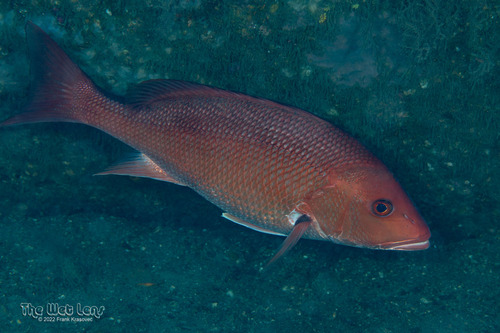
Characteristics: The body shape of the northern red snapper is very similar to that of other snapper species, including mangrove snapper, mutton snapper, lane snapper, and dog snapper. All these snappers share a sloped body profile, medium-to-large scales, a spiny dorsal fin, and a laterally compressed body. Northern red snapper have short, sharp, needle-like teeth, but lack the prominent upper canine teeth found on mutton, dog, and mangrove snappers. This species is relatively large and red in overall color, with light red body coloration and more intense pigment on the back. It has 10 dorsal spines, 14 soft dorsal rays, three anal spines, and 8 to 9 anal soft rays. Juvenile fish shorter than 30–35 cm often have a dark spot on their sides, below the anterior soft dorsal rays, and this spot fades as the fish ages. Northern red snapper reach sexual maturity at a length of around 39 cm (15 in). The common length of an adult is 60 cm (24 in), and individuals can grow as large as 100 cm (39 in). The maximum published weight for this species is 50 lb 4 oz (22.79 kg), and the oldest reported age is over 57 years.
Distribution and habitat: Northern red snapper are found in the Gulf of Mexico, the Caribbean Sea, and the southeastern Atlantic coast of Mexico and the United States, at depths between 30 and 620 feet. They are much less commonly found as far north as Massachusetts. This species most commonly inhabits waters from 9–60 m (30–200 ft), but can occasionally be caught as deep as 90 m (300 ft). In Latin American Spanish, this species is known as mero, huachinango, pargo, or chillo. Northern red snapper stay relatively close to the seabed, and inhabit rocky bottoms, ledges, ridges, and artificial reefs including offshore oil rigs and shipwrecks. Like most other snappers, northern red snapper are gregarious and form large schools around wrecks and reefs, and these schools are usually made up of fish of very similar size. The preferred habitat of this species changes as it grows and matures, due to increasing need for cover and shifting food habits. Newly hatched red snapper spread across large areas of open benthic habitat, then move to low-relief habitats such as oyster beds. As they near one year of age, they move to intermediate-relief habitats, while the previous year's mature fish move on to high-relief reefs that have space for more individuals. Around artificial reefs such as oil platforms, smaller fish spend time in the upper part of the water column, while more mature and larger adults live in deeper areas. These larger fish do not allow smaller individuals to share their territory. The largest red snapper spread across both open habitats and reefs.
Reproduction and growth: Diaz collected weight versus length data for L. campechanus for the U.S. National Marine Fisheries Service. As northern red snapper grow longer, they gain weight, but the relationship between length and weight is not linear. For nearly all fish species, the relationship between total length (L) and total weight (W) can be expressed by the equation W = cLᵇ. For all fish species, b is always close to 3.0, while c is a constant that varies between species. Diaz reported that for northern red snapper, c=0.000010 and b=3.076, where length input is in centimeters and resulting weight is in kilograms. Szedlmayer et al. published length versus age data for L. campechanus in a primarily artificial reef environment off the coast of Alabama, U.S. The relationship they reported is TL(age) = 1,025 (1 – e^( -0.15 age)), with N=409 and R = 0.96. For the first five years of growth, growth can be approximated as approximately linear, following the equation TL(age) = 97.7 age + 67.6, with N = 397 and R = 0.87. For both equations, age is measured in years and total length is measured in millimeters. Multiple published studies confirm that L. campechanus grows most rapidly during its first 8–10 years. Northern red snapper shift between different habitat types as they grow. When newly spawned, red snapper settle across large areas of open benthic habitat. Fish under 1 year old move to low-relief habitats to access food and cover, preferring oyster shell beds when they are available. In the next growth stage, fish outgrow low-relief habitats and move to intermediate-relief habitats, as the previous year's age 1 snapper move on to the next stage. By around age 2, snapper seek out high-relief reefs that have low densities of larger snapper. Around oil platforms, smaller snapper occupy the upper water column, while larger, older snapper occupy the deeper areas of the platforms and large benthic reefs, and block smaller snapper and other fish from using these habitats. Despite having local habitat preferences, Szedlmayer found that out of 146 tagged, released, and recaptured L. campechanus followed for approximately one year, 57% remained near their release site, and 76% were recaptured within 2 km of their release site. The longest movement recorded from a single fish was 32 km. A northern red snapper reaches sexual maturity between two and five years old, and an adult can live for more than 50 years. Research conducted from 1999–2001 found that red snapper populations off the coast of Texas reach maturity faster and at a smaller size than populations off the coasts of Louisiana and Alabama.
Commercial and recreational use: Northern red snapper is a prized food fish, caught by both commercial and recreational fishers. It is sometimes used in the Vietnamese dish canh chua (sour soup). Red snapper is the most commonly caught snapper in the continental United States, making up almost 50% of the total U.S. continental snapper catch, while other similar species are more common in other regions. Northern red snapper eat almost anything, but prefer small fish and crustaceans. They can be caught with both live and cut bait, and will also take artificial lures, though with less activity. They are commonly caught up to 4.5 kg (10 lb) and 510 mm (20 in) in length, but fish over 18 kg (40 lb) have been caught. Recreational fishing for northern red snapper has been popular for a long time, and is mostly restricted through fishing limits designed to maintain a sustainable population. The first minimum size limit for northern red snapper was introduced in 1984, after a 1981 report described rapidly declining commercial and recreational harvests. From 1985 to 1990, the annual recreational catch of red snapper was around 1.5 million fish. From 1991 to 2005, the recreational catch was substantially higher, varying between 2.5 and 4.0 million fish per year. When northern red snapper bite on a fishing line, they tend to nibble and pick at the bait, so a soft touch is needed when attempting to hook them. Because older red snapper prefer structured habitat, anglers use bottom fishing over reefs, wrecks, and oil rigs, and use 50-lb class line and gear. Since anglers need to both select the correct bait and present it properly, they often use multiple hooked baits. Favorite baits include squid, whole medium-sized fish, and small strips of fish such as amberjack. While many northern red snapper are caught from the bottom, larger fish can sometimes be caught with heavy jigs (artificial lures), often tipped with a strip of bait, or by freelining baits at the appropriate upper water level. Interest in recreational northern red snapper fishing, particularly in the Gulf of Mexico, has increased dramatically. From 1995–2003, the number of Louisiana fishing charter guide license holders increased eight-fold. In 2017, the Gulf of Mexico Fishery Management Council estimated the commercial value of the red snapper fishery was $129 million. While specific figures for the economic impact of recreational red snapper fishing are not available, this activity clearly has a significant economic impact on coastal communities through tourism and fishing-related activities. Since 1990, the total catch limit for northern red snapper has been split 49% for recreational fishermen and 51% for commercial fishermen. Commercially, northern red snapper are caught with multiple-hook gear fitted with electric reels. Fishing for red snapper has long been a major industry in the Gulf of Mexico, but permit restrictions and changes to the quota system for commercial snapper fishermen in the Gulf have made the fish less commercially available. Researchers estimate that bycatch of young red snapper, especially by shrimp trawlers, is a significant concern. Genetic studies have shown that many fish sold as red snapper in the United States are not actually L. campechanus, but are other species in the snapper family. Species substitution for red snapper is more common in large chain restaurants that serve a uniform nationwide menu; in these cases, suppliers provide a less costly, usually imported substitute for true red snapper. In countries such as India, where native northern red snapper do not occur in local oceans, John snapper and Russell snapper are sold labeled as "red snapper".