About Lutjanus biguttatus (Valenciennes, 1830)
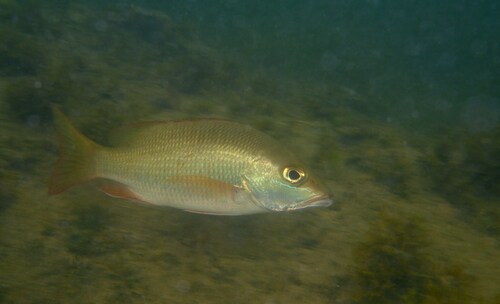
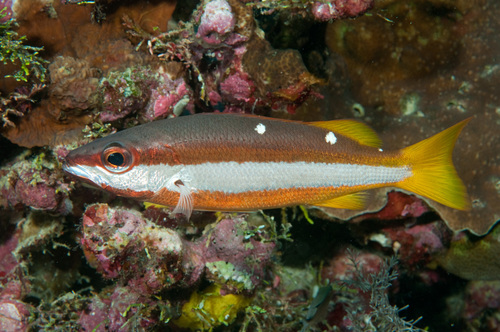
Lutjanus biguttatus has a very slender, fusiform body, with a snout that has a low, gently sloping profile. The knob and incision on its preoperculum are weak. In its mouth, vomerine teeth are arranged in a triangular patch with a posterior extension, or in a rhombus shape, and there are no teeth on the tongue. Its caudal fin is truncate. The dorsal fin has 11 spines and 12 soft rays, while the anal fin contains 3 spines and 8 soft rays. Adult individuals have a greyish back, and a wide horizontal white stripe that runs from the mouth to the caudal peduncle, with a reddish-brown stripe bordering each side of the white stripe. There are two white spots on the back, underneath the base of the dorsal fin. Juveniles are mostly white with a grey back, a dark brown longitudinal stripe along the lateral line, and two indistinct white spots on the back. The maximum recorded standard length for this species is 25 cm (9.8 in), though 15 cm (5.9 in) is a more typical size. This species occurs in the Indo-Pacific region. Its distribution ranges from the Maldives and Sri Lanka through the Andaman Sea and the Malay Archipelago, east as far as the Solomon Islands, north as far as the Philippines, and south to Australia; records also exist from locations further east: Samoa, Fiji, and the Caroline Islands. In Australia, it has been recorded in Western Australia from Hibernia Reef to Scott Reef, at Ashmore Reef in the Coral Sea, and off Cape York Peninsula in northern Queensland. It inhabits coral reefs at depths between 3 and 30 meters (9.8 and 98.4 ft).