About Lutjanus argentimaculatus (Forsskål, 1775)
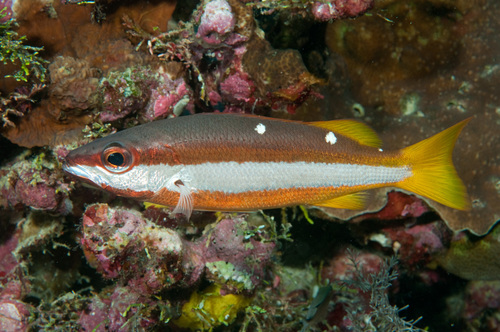
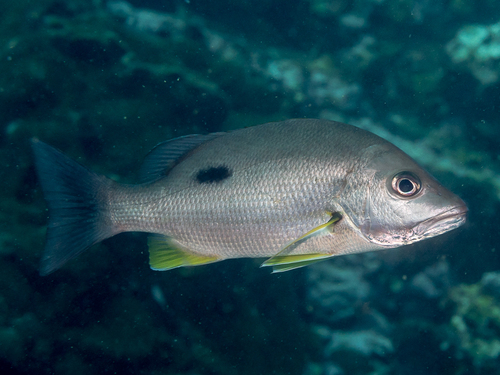
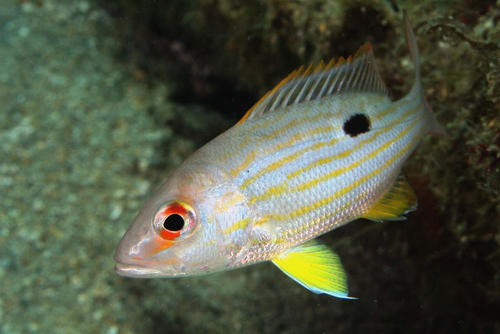
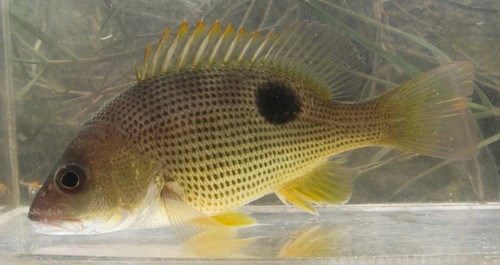
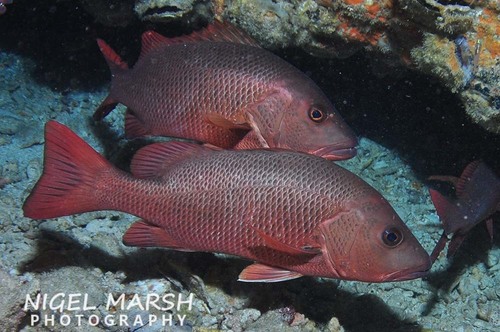
The mangrove red snapper, Lutjanus argentimaculatus (Forsskål, 1775), has coloration that ranges from burnt orange, copper, and bronze to dark reddish-brown, and varies based on the fish’s age and environment. Younger fish caught in estuarine areas are often darker than older fish from offshore reef areas, and have lighter vertical bands running down their flanks. The maximum recorded length for this species is 150 centimetres (4.9 ft), though 80 centimetres (2.6 ft) is the most common size. Like other tropical snappers in the family Lutjanidae, mangrove red snappers (also called mangrove jacks) have prominent fangs in their jaws used for seizing and holding prey, similar to the canine teeth of mammals. These teeth can cause serious injury to unwary fishers. In reef areas, mangrove red snappers are sometimes confused with the two-spot red snapper (also called red bass, Lutjanus bohar), a species known to carry ciguatera toxin. Red bass are typically darker in color, have fewer dorsal-fin spines, have scale rows on their back that rise obliquely from the lateral line, and have a deep groove running from the nostrils to the eyes.
The mangrove red snapper is native to the Indian Ocean and western Pacific Ocean, ranging from the African coast east to Samoa and the Line Islands, and from the Ryukyu Islands in the north south to Australia. It has also rarely been recorded in the Mediterranean Sea, after completing Lessepsian migration from the Red Sea starting at least 1979. As its common name suggests, the mangrove red snapper is most often found in mangrove-lined estuarine systems, though some individuals, particularly juveniles, move into fully freshwater systems. The species migrates to offshore reefs to spawn. As they mature, mangrove red snappers move into open waters, sometimes hundreds of kilometers from the coast, to breed. These larger fish are sometimes caught by bottom-fishers using heavy tackle, but remain difficult to land due to their speed and their proximity to sharp reef bottoms.
Like many marine fish species, the mangrove red snapper is a broadcast spawner. In Northeastern Queensland, spawning takes place during the austral spring and summer: it begins around October, peaks in December, and then declines through January and March over the rest of summer. In contrast, spawning occurs during boreal autumn in Thailand, from late September to November. Both of these spawning periods align with high rainfall and decreasing water temperatures, which may result in nutrients being flushed into inshore waters through alluvial runoff. Because juveniles are still present in March and April in Thailand, Thai mangrove jacks may continue spawning into boreal spring. In Palau, spawning aggregations of mangrove jacks have been observed on reef lagoons and outer reef slopes. Spawning is influenced by lunar cycles, as it is for many other lutjanids, and peaks between days 14 and 18 of the lunar month, around the full moon. This timing is thought to provide the most advantageous tides for the survival of subsequent eggs and larvae. A 4.6 kilogram (10 lb) female may produce up to 1.3 million eggs, which are transparent, pelagic, and non-adhesive (they do not stick to substrate). At 28 °C (82 °F) and 32 ppt salinity, eggs begin mitosis 1.5 hours after spawning, an embryo forms 12 hours after spawning, and hatching occurs 16 hours after spawning. Yolk resorption is complete 72 hours after hatching, at which point larvae begin feeding. Larval growth is slow during the first week of life, but accelerates greatly over the following two weeks. Immature fish are found in inshore areas including rivers, while mature fish are most often caught offshore. Males mature at slightly smaller sizes than females: the length at which 50% of sampled fish were mature (Lm50) was 531.4 mm fork length for females, and 470.7 mm fork length for males. The maximum reported age for the mangrove red snapper is 31 years.