About Lutjanus apodus (Walbaum, 1792)
Scientific name: Lutjanus apodus (Walbaum, 1792)
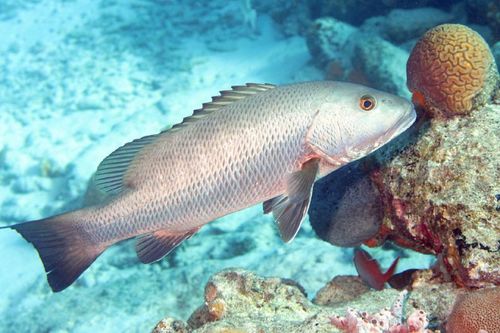
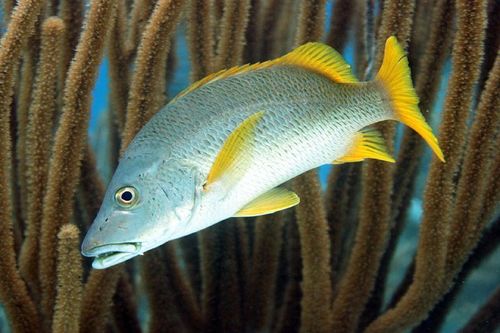
Description: The schoolmaster snapper has a moderately deep, robust, slightly compressed body, with a long pointed snout and large mouth. One upper pair of canine teeth is distinctly larger than the back teeth in the lower jaw, and remains visible even when the mouth is closed. Vomerine teeth are arranged in a chevron or crescent-shaped patch, with a line of similar teeth extending backward from the center of the patch. The preoperculum has a weakly developed incision and knob. This species has a protrusible upper jaw that is mostly covered by the cheek bone when the mouth is closed, and both pairs of nostrils are simple unmodified holes. The dorsal fin is continuous, with only a slight incision separating its spiny section from its soft-rayed section. The dorsal fin has 10 spines and 14 soft rays, while the rounded anal fin contains 3 spines and 8 soft rays. The inner scale rows on the back run parallel to the lateral line. The caudal fin is slightly emarginate or truncate. The pectoral fins are longer than the distance between the furthest point of the snout and the posterior edge of the preopercle, and they extend to the level of the anus.
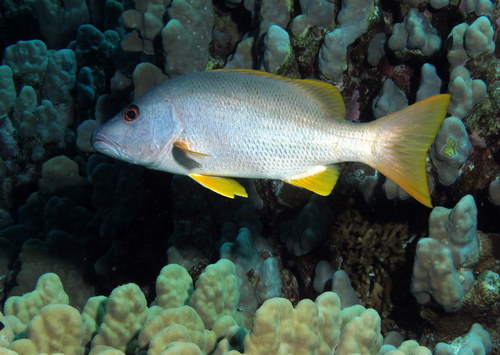
The body coloration is olive gray to brownish on the upper back and upper sides, with yellow to reddish mottling around the head. The lower sides and belly are paler, and there is no dark lateral spot below the anterior section of the soft dorsal fin. Eight narrow, light vertical bars run along the body sides; these bars may fade or be completely absent in large adults. A solid or broken blue line runs beneath the eye, and this line may also disappear as the fish grows. From the upper jaw to the tip of the fleshy opercle, this line is often broken into segments that look like dashes and spots. The fins and caudal fin are bright yellow, yellow-green, or pale orange, and blue stripes are present on the snout. This species reaches a maximum fork length of 79.1 cm (31.1 in), with 35 cm (14 in) being a more common size, and has a maximum published weight of 10.8 kg (24 lb).
Distribution: The schoolmaster snapper occurs in the western Atlantic Ocean, including Bermuda and the southeastern coast of the United States, ranging from Cape Canaveral, Florida south to the Bahamas and into the Gulf of Mexico. In the Gulf of Mexico, its range extends from the Florida Keys as far north as Tampa, Florida, then west from Alabama along the coast to the Yucatan Peninsula and northwestern Cuba. It is found throughout the Caribbean Sea. It has been recorded as far north as Massachusetts, but these records are of juveniles that cannot survive northern winters. It is normally found at depths between 1 and 50 m (3 ft 3 in to 164 ft 1 in), with a single recorded observation at 89 m (292 ft). Adults typically stay near shore, sheltering around elkhorn coral and gorgonian coral. Large adults are sometimes found on the continental shelf. Most individuals are found at depths up to 4 m (13 ft). At night, schoolmaster snappers can double their daytime home range, most often expanding into seagrass beds.
Reproduction and growth: Schoolmaster snappers are gonochoristic, meaning individuals are either male or female. They spawn throughout most of the year, with the majority of spawning activity taking place in mid to late summer; off Cuba, spawning occurs from April to June. They reproduce through open-water spawning, where both males and females release their gametes into the water at the same time. After fertilization, the eggs settle to the substrate, where they are left unguarded. The schoolmaster snapper is a slow-growing, long-lived species with a maximum recorded age of 42 years. As fish grow longer, their weight increases, though the relationship between length and weight is not linear. For nearly all fish species, this relationship can be expressed by the equation W = cLᵇ, where b is always close to 3.0 for all species, and c is a coefficient that varies between species. A study of the weight-length relationship for 100 schoolmaster snappers ranging from 2 to 7 inches (50 mm to 180 mm) in length found the coefficient c was 0.000050015 and the exponent b was 2.9107. This relationship estimates that a 12.5-inch (320 mm) schoolmaster snapper will weigh approximately 2.2 lb (1 kg).
Commercial and recreational use: Alongside other snapper species, the schoolmaster snapper is targeted by both recreational and commercial fishermen, but it is not as frequently targeted by commercial fisheries as other co-occurring Lutjanus snappers. It is reported to have excellent eating quality. However, human consumption of this species has been linked to cases of ciguatera poisoning. Fishing rules for schoolmaster snapper in U.S. state waters are set individually by each state but share common features. For example, in Florida, the minimum landing length for schoolmaster snapper is 10 inches (250 mm) total length, with a daily bag limit of 10 fish per angler. The 10-fish limit is an aggregate that includes all snapper species. Anglers use light spinning and baitcasting tackle to catch schoolmaster snapper. Live shrimp, live baitfish, shrimp pieces, and cut bait are the most effective natural baits. Jigs are the most effective artificial bait, though artificial baits are rarely used and rarely successful for this species.