About Luscinia megarhynchos C.L.Brehm, 1831
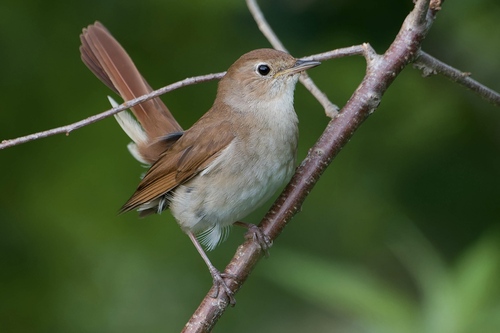
Description. The common nightingale, with the scientific name Luscinia megarhynchos C.L.Brehm, 1831, is slightly larger than the European robin, measuring 15–16.5 cm (5.9–6.5 in) in length. Its upperparts are plain brown except for a reddish tail, and underparts range from buff to white. Males and females have similar plumage. The eastern subspecies L. m. golzi and the Caucasian subspecies L. m. africana have paler upperparts, a stronger facial pattern, and a distinct pale supercilium. The male nightingale’s song is widely described as one of the most beautiful sounds in nature, and it has inspired a wide range of human creative works including songs, fairy tales, operas, books, and a large volume of poetry. Historically, however, most people did not know that female nightingales do not sing. Distribution and habitat. This is a migratory insectivorous species. It breeds in forest and scrub across Europe and the Palearctic, and winters in Sub-Saharan Africa. It does not occur naturally in the Americas. Its breeding range is shifted further south than that of its very close relative, the thrush nightingale (Luscinia luscinia). It nests on or close to the ground in dense vegetation. Research conducted in Germany identified a set of geographical factors that define the common nightingale’s preferred breeding habitat: elevation less than 400 m (1,300 ft) above mean sea level, mean air temperature above 14 °C (57 °F) during the growing season, more than 20 days per year with temperatures exceeding 25 °C (77 °F), annual precipitation less than 750 millimetres (30 in), an aridity index lower than 0.35, and no closed forest canopy. In the United Kingdom, the common nightingale is at the northern limit of its range, which has contracted in recent decades; this contraction has led to the species being placed on the UK’s red conservation list. Despite local efforts to protect its preferred coppice and scrub habitat, the UK population fell by 53 percent between 1995 and 2008. A survey carried out by the British Trust for Ornithology in 2012 and 2013 recorded approximately 3,300 breeding territories, most of which were clustered in a small number of counties in South East England and East Anglia, most notably Kent, Essex, Suffolk, East Sussex, and West Sussex. In contrast, the total European breeding population is estimated at between 3.2 and 7 million pairs, which gives the species an overall green conservation status of least concern. Behaviour and ecology. Common nightingales got their name because they often sing both at night and during the day. The name has been in use for more than 1,000 years, and was already highly recognizable in its Old English form nihtegale, which translates to "night songstress". Early writers assumed the female nightingale was the one that sang, but singing is actually done exclusively by the male. The male’s song is loud, with an impressive range of whistles, trills, and gurgles. Individual male nightingales can produce varying numbers of distinct song types, and different individuals can sing the same song type with minor variations between individuals or between consecutive renditions. This leads to extraordinarily large overall song repertoires: an average of 190 distinct song types per individual, with a maximum recorded of 250. Its song is particularly noticeable at night because very few other birds sing at this time, which is why the common nightingale’s name includes "night" in many languages. Only unpaired males sing regularly at night, and nocturnal singing likely functions to attract a mate. Singing at dawn, during the hour before sunrise, is thought to be important for defending the male’s territory. Common nightingales sing even more loudly in urban or near-urban environments, to compensate for higher levels of background noise. The most distinctive characteristic of the species’ song is a loud whistling crescendo that is not present in the song of its close relative, the thrush nightingale. It has a frog-like alarm call. The common nightingale acts as a host for the acanthocephalan intestinal parasite Apororhynchus silesiacus.