About Luscinia luscinia (Linnaeus, 1758)
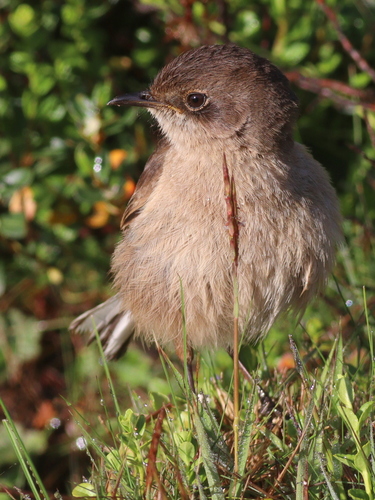
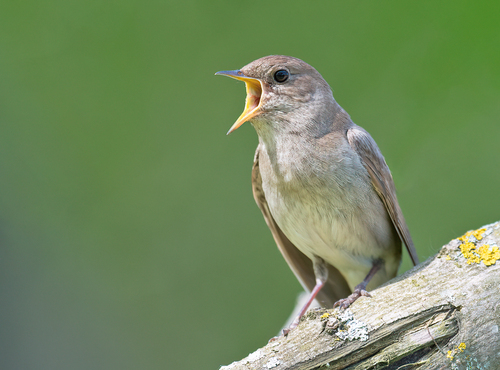
The adult thrush nightingale (Luscinia luscinia) has a total length of approximately 16 centimetres (6.3 in) and a wingspan of roughly 18 centimetres (7.1 in). Its head, nape, and entire upper body are dark brown with a faint olive tinge; this colour is much deeper than the colour of the common nightingale, and it is not rufous at all. The upper tail-coverts have less of an olive tint, while the tail feathers are dark rufous-brown. The lores and ear-coverts are brownish-black, and the chin and throat are pale buff or whitish, mottled with brown, and paler in colour than the common nightingale's throat. The sides of the throat have brown spots, and the pale breast feathers have brown central bands that give the breast a mottled look. The under tail-coverts are buff, and sometimes have brown bars or markings. The wing feathers and wing-coverts are dark brown and less rufous than those of the common nightingale. The beak, legs, and feet are brown, and the irises are dark brown. Male and female thrush nightingales look very similar to one another, while juvenile birds are darker and have more extensive mottling. This species has a single annual moult that takes place in July and August, at the end of the breeding season. The thrush nightingale is a migratory bird species. It breeds in eastern Europe and the western portion of temperate Asia. The northern limit of its summer breeding range reaches Denmark, southern Finland, Norway and Sweden, the Baltic States, the Republic of Karelia, Kostroma, Vologda, Perm, Kazakhstan, Turkestan, and Altai. The southern limit of its breeding range runs from Austria and the Czech Republic, through Romania, Bulgaria, southern Russia, Ukraine, the Crimea, and the northern Caucasus. It overwinters in Africa south of the Sahara Desert, and it is an occasional visitor to the British Isles. Within its breeding range, the thrush nightingale inhabits damp deciduous woodland, typically composed of alder and birch trees. It prefers thick undergrowth with brambles, dense shrubs, and tangled vegetation in swampy areas and near water. In its winter range, it occurs in dense thickets of thorn bush, especially in valley bottoms near watercourses, and sometimes in thick vegetation at the edge of woodland. The thrush nightingale acts as a host for the acanthocephalan intestinal parasite Apororhynchus silesiacus. The thrush nightingale feeds mostly on the ground, where it eats earthworms, spiders, and the adults, larvae, and pupae of insects including beetles, small moths, ants, and flies. In autumn, it also eats berries from currants (Ribes spp.) and elders (Sambucus spp.). Before migrating across the Sahara, thrush nightingales build up fat reserves. Experiments have found that magnetic cues may trigger this behaviour; simulating the magnetic field present in northern Egypt encouraged thrush nightingales preparing to migrate from Sweden to build up additional body fat.