About Luscinia brunnea (Hodgson, 1837)
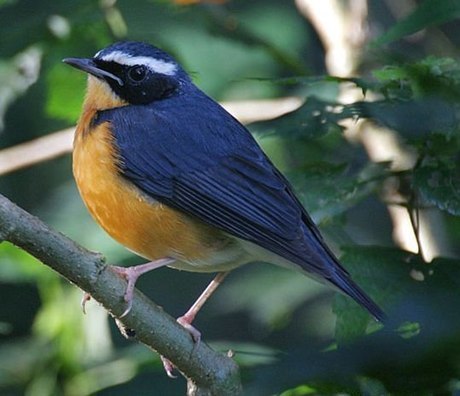
The Indian blue robin, scientific name Luscinia brunnea (Hodgson, 1837), measures 15 cm long, a similar size to its close relative the bluethroat. Adult males have blue upperparts, rufous underparts, a bright white supercilium, a black mask that extends down the neck, and whitish lower belly and undertail. Females have olive brown upperparts, buff underparts, a light eye-ring, a rufescent rump, and buffy breast and flanks. Young birds are dark brown with buff spots. The nominate subspecies breeds from Eastern Afghanistan to the eastern Himalayas. Subspecies wickhami (Stuart Baker, 1916) breeds in the Chin Hills of western Myanmar and is recorded as non-migratory. This species is insectivorous and feeds primarily on the ground. It stays hidden in undergrowth, hops along the ground, and frequently flicks and fans its tail. The breeding season runs from May to July. Its nest is a large cup made of vegetation, placed on the ground between the roots of a large fir tree or in a depression, and lined with roots, hair, and down. The typical clutch contains 4 light blue eggs. Only the female is thought to incubate the eggs, but both adults feed the young. The common cuckoo Cuculus canorus is recorded in older literature as a brood parasite of this species. Migratory populations arrive at their Himalayan breeding grounds in May and leave in September, with southward migration beginning in August. During migration, they can be found as passage migrants across all of peninsular India. In winter, they are found mainly in the hill forests of southern India, the Western Ghats, and Sri Lanka. They arrive at their wintering grounds in mid-September and leave in mid-April. A survey in the Nilgiris found more males than females, which may indicate differences between males and females in migration timing or differing wintering area preferences. At Point Calimere, this species is regularly trapped during October and November on its return migration from Sri Lanka, but is rarely trapped during southward migration, leading to suggestions that it follows different migration routes for the two directions. It typically inhabits dense, dark forest with undergrowth and leaf litter. It sings and calls while on its wintering grounds. Its song is a sudden, sharp series of whistles that ends in a rapid sequence of notes. It also produces a sharp, low clicking alarm call.